Thursday, July 09, 2009
What Do To About the Screws?
The Guardian has today broken a story that’s actually shocking. When there’s corruption in politics or journalism, it’s easy to affect being shocked, when actually you know that either it’s not that significant in the grand scheme of things, or you always assumed a bit of it went on, or both. The News of the Screws hacking into three thousand people’s phones with impunity – again, literally with impunity, as it appears that the legal authorities knew about it but, far from doling out punishment, helped cover it up – is a type and scale of law-breaking that left me open-mouthed.
You can read in The Guardian and, I imagine, many more outlets today about The News of the World’s massive programme of illegal phone-cracking – including the then Deputy Prime Minister and the Minister with responsibility for the media, which looks like a multinational using its money and might to compromise national security in quite a significant way – about their massive hush money pay-outs as part of an incredible cover-up, about what some of the victims have to say for themselves and about Andy Coulson, David Cameron’s Director of Communications, who edited The News of the World when it was riddled with this criminal culture (if indeed it’s stopped today).
No doubt debate over a privacy law will erupt again. I’m wary of it, but in any case it’s irrelevant to this case – they’ve broken the law several thousand times anyway. Adding another law is hardly going to put them off. It’s not as if anyone was enforcing the existing laws, is it?
My main worry is over the enormous power wielded by a giant multinational company that’s enabled it to duck all the laws that apply to the rest of us – even when all the relevant authorities were involved.
The People Who Should Have Acted – And Didn’t
We know that the Labour Party has been crushingly afraid of Mr Murdoch’s press ever since it was defeated in 1992. We know that they’ve kow-towed and changed their policies, first to get The Sun’s backing to get into government and then, in government, not to lose it. It’s no surprise that, with defeat looming and every indication that Mr Murdoch does not back losers, Labour people are suddenly today starting to be critical of News International – too little, too late. Particularly when their immediate reaction to someone stealing people’s privacy on a massive scale must be, ‘but that’s our job!’
We know that David Cameron has been desperately attempting to get the same sort of deal with Mr Murdoch that Mr Blair once did. Part of that was to appoint as his head PR man the disgraced former News of the World editor Andy Coulson, who was one of the fall guys when a tiny, tiny fraction of this story came out three years ago. Mr Cameron has now said that he is “very relaxed” about his far-right-hand-man being a criminal gang boss, apparently because the hush money was paid out after he left. Well, hush money to cover up a crime isn’t usually paid to the victim before the crime takes place, is it, but when they eventually find out? After having such a massive hit with Gordon Brown’s PR man Damian McBride sending just a couple of e-mails that were legal but nasty, Mr Cameron must be sweating buckets when his own equivalent led a team that was committing thousands of crimes.
The power that The News of the World, its stablemates and its master exert over the two biggest political parties is bad enough. What’s terrifying about this case is that the authorities that should have acted not only didn’t, but actively assisted the cover-up.
- The Metropolitan Police didn’t fully investigate – and, astonishingly, though they managed to find evidence that many people’s phones had been broken into, they didn’t even tell any of the victims that a crime had been committed against them, nor that their security might still be compromised.
- The Crown Prosecution Service brought charges against one designated fall guy, then did bugger all with all the rest of the evidence.
- The Press Complaints Commission ‘investigated’ to no effect whatever. What’s the point of this press establishment club?
- The Parliamentary Select Committee that ‘investigated’ the last case were lied to by senior News International executives, and went no further.
As Liberal Vision pointedly puts it this morning, “Rupert Murdoch: I liked it so much that I bought your country’s legal system”.
Is There Any Punishment That Would Matter to Murdoch?
This is vastly more serious than MPs’ expenses. Surely it’ll be hammered just as hard and just as long in the… media… Ah. I see the problem. So, with the Labour Government and Conservative Opposition compromised, with the press authorities, legal authorities and Parliamentary authorities all failing, who on Earth will hold this conspiracy to account?
Freedom of the press is vital. Giving the government power over it is deeply worrying. But while the government itself should play no part in individual cases, it must set a framework within which action is taken. The Labour Government has been such an overwhelming bully over our personal lives that it’s easy to forget that, just as the media, the courts and the rest of us have to keep watch on its power to bully, part of the point of having a government at all is to stand up to other bullies on our behalf.
I have no legal background at all, but I suspect it may be too late to do anything about this case on the scale of punishment that it deserves – even if the various authorities belatedly get off their arses. The simple fact is, a fine on the scale any of us have heard of before is unlikely to cut it. News International is simply so huge that it can take a few million here or there without breaking stride. It’s an occupational hazard – it’s no punishment, let alone deterrent (and the mind boggles at how a corrupt media giant might be induced to undergo any form of rehabilitation).
What this deserves is for any paper so riddled with criminal activity to be either closed down or sold off, and its owner barred from buying any replacement – and the whole British arm of the Murdoch empire to be dissolved if investigations reveal that other papers or TV channels were doing it too. I suspect our toothless media law framework has absolutely nothing like the power or inclination to deal with this sort of endemic institutional corruption. The Liberal Democrats should commit to changing it to something with a whole lot more bite before the next time this sort of thing emerges (and it will).
Three years ago, we saw one individual journalist apparently hung out to dry by the Murdoch empire when a tiny fraction of this exploded into the limelight. He said it was only him; The News of the World said it was only him; News International said it was only him. He went to prison. We now know that he was just the tip of the iceberg, that every single News International employee who commented on this was lying through their teeth, and that any who took the stand were perjurers.
Like gangsters who agree to take the fall and not name everyone else involved, what was the price for his silence? Another job? A big pay-off? Surely a police investigation into perverting the course of justice has to start today.
So, while going after individual journalists who have been implicated in this vast conspiracy is necessary, it is far from sufficient when the corruption and illegal practices are blatantly systemic in at least this one newspaper. Given the massive hush money ladled out by Mr Murdoch, The Sun and the rest of News International’s UK pawns must be thoroughly investigated, too. As well as officers of the police and the courts, whose competence, judgment and probity are all now under serious question.
If it’s true that fines are the only shot in the armoury for newspapers themselves, then surely News International have already set their own market rate. They’ve paid three sets of cash that we know of in secret compensation to their victims, totalling around a million pounds. It turns out there are something in the region of three thousand victims in total. That’s a nice easy sum to do, then, isn’t it?
One billion pounds, please, Mr Murdoch, and after that we’ll look at who goes to prison.
Labels: British Politics, Conservatives, Corruption, Labour, Meddling In Things That Are Nobody's Business But Your Own, Newspapers
Thursday, July 02, 2009
You Know You’re Getting On A Bit When…
“Before we go any further, Mr Rumbold, Miss Brahms and I would like to complain about the state of our drawers. They’re a positive disgrace.”Mrs Slocombe, Mr Rumbold, Miss Brahms and Mr Humphries, from – appropriately for today’s return to its straitened economic times – the Are You Being Served? episode Our Figures Are Slipping.
“Your what, Mrs Slocombe?”
“Our drawers. They’re sticking. It’s always the same in damp weather – Miss Brahms could hardly shift hers at all this morning. They sent up a man who put beeswax on them, but that didn’t work.”
“I’m not surprised.”
“I think they need sandpapering.”
“Would that help, do you think?”
“I puffed French chalk on mine, and they’re smooth as silk.”
“Perhaps you could puff some French chalk over Mrs Slocombe’s.”
“Would that solve your problem, Mrs Slocombe?”
“They ought to be changed. I’ve had them ever since I’ve been here!”
“I think it would pay us to examine our whole customer handling technique. And to that end, I shall be holding a course in salesmanship this evening, after the store closes.”It’s sad to see that Karl Malden went on the same day (I always remember him from Where the Sidewalk Ends, a favourite film noir), with both actors known for remarkably long-lasting marriages. Good for them. And who’d have thought Miss Brahms would go first?
“You mean in our own time?”
“It’s very short notice. There’s my pussy to consider.”
“I beg your pardon?”
“Who’s going to let it out?”
If you’re wondering, the clips of Mrs Slocombe played on this morning’s Today Programme – including her exchange with the woman billed as The Large Brim With Fruit – were taken from the episode Camping In (naturally), which I found just after Our Figures Are Slipping on cranking up our steam-powered laserdisc player to watch our giant disc of Are You Being Served? last night.
She always did very well.
Labels: Comedy, Obituary, The Today Programme
Tuesday, June 30, 2009
DVD Taster: Delta and the Bannermen
“But the brochure shows a space cruiser – not an old bus.”
“Old bus? This is a very expensive conversion!”
That Golden Moment
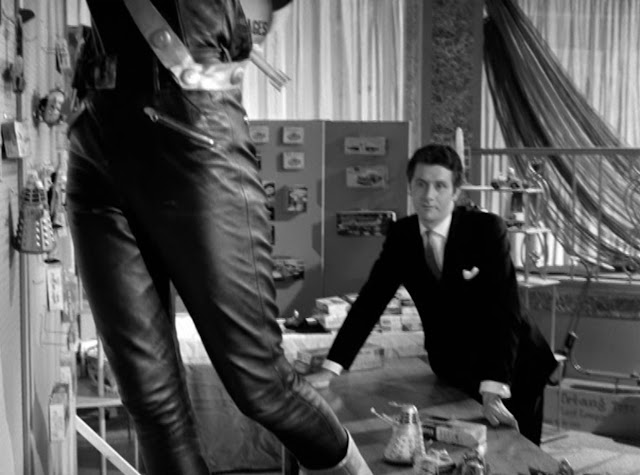
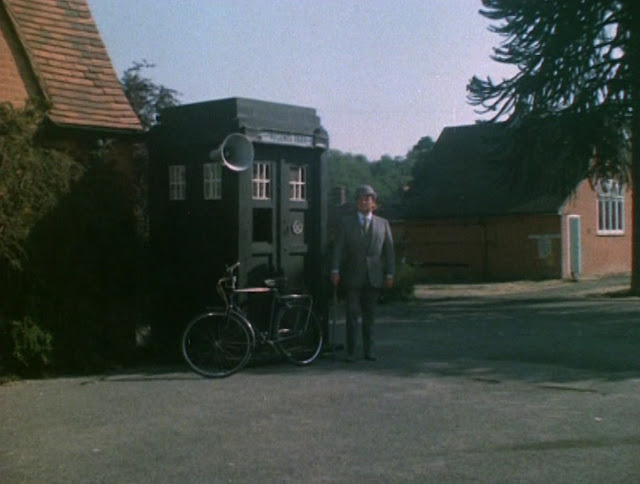
The Doctor and Mel win tickets for a trip to Disneyland in the 1950s with a gaggle of purple blobby alien rock and roll fans, in itself a marvellous Doctor Who idea – not least because you know something’s going to go wrong long before they reach the land of the Big Frozen Head. There are lovely exchanges about notorious travel firm Nostalgia Trips, with Tollmaster Ken Dodd giving his best ‘oh, I’ve never been so’ looks every time someone disses the sponsor, but the most fabulous moment in the script is when it’s revealed that the tour bus has been converted at great expense from the latest star cruiser in order to look so cheap. That’s got an irresistibly Who-ish ring to it, not least when they open the back up and reveal huge great Star Destroyer engines. And with the bus fitting in, so do the passengers – the aliens all go through a “transformation arch” to put them in human drag. I like to think that the same was true of the tourists in Voyage of the Damned, another doomed time-tour, so that if Kylie had lived, the Doctor’s latest blonde would suddenly have turned back into a blobby purple thing*. Serve him right for being so shallow!
Something Else To Look Out For
There are several entertaining moments and endearing characters in this – I love Sylv’s Doctor operating the console with both hands, a brolly and a foot, clearly inspiring that modern Mr Tennant, just as I suspect the road on which Sarah Jane Smith has her adventures is named not after a Liberal Prime Minister but this story’s red-tongued villains – but what do I think of the whole thing? Well, I love all Doctor Who, obviously, and there’s none of it I don’t enjoy watching. And out of the round-about two hundred Doctor Who stories broadcast to date, this would almost certainly make the top… Two hundred.
If you’ve read other reviews of Delta and the Bannermen, both its defenders and its critics tend to cite its ‘lightweight’ and ‘silly’ nature. My trouble with it, on the other hand, is that while I’m rather fond of lightweight, silly stories, this simply isn’t lightweight or silly enough – particularly with the comedy genocide at the heart of the story, it’s often ickily inappropriate, and much of the dialogue is far too forced to be witty. Its over-emphatic style fails to hit whimsy or archness and instead talks down to the audience, both too earnest and too lightweight about genocide. It would have been much better as a whimsical two-parter of ‘the Doctor’s holiday’, with the murderous Bannermen replaced by, if a villain’s needed at all, someone appropriately camp and unambitious (like the Hooded Claw). Paradise Towers, on the other hand, the story that immediately preceded it and which similarly splits critical opinion, is brilliant, both scarier and much funnier. Let’s hope that one’s out soon. On the bright side, there are two bumbling CIA agents who may contribute little to the plot, but calling the White House from “Wales, in England” was funny at the time and funnier these days (shame there’s no second commentary by the current production team sending it up), despite the improbability of 60-odd-year-old G-Men in 1959 complaining there’s no rock and roll on the radio rather than investigating anyone who listens to it as a sex-crazed commie prevert.
Other elements that may or may not strike a chord include all the ’50s nostalgia – trading in on the music, skating over the unpleasant social attitudes – Don Henderson hamming it up (actually salmoning it up, fact fans), fun with motorbikes and a unique conception of the show that suggests the author hadn’t seen it since Patrick Troughton left two decades earlier in The War Games (out next week, and with a terrific trailer on this disc). There’s a big sky bully / galactic government who the Doctor can report the baddies to for a ticking-off; space and time travel has someone checking your tickets; there’s a contrivedly enigmatic old man who feels like a half-remembered version of a retired Time Lord – it doesn’t refer explicitly to the series’ past, but instead pastiches it to the level of cliché, with all the same clutter in the plot but none of the detail that made it distinctive.
Extra features include commentaries, text notes and surprisingly lengthy scenes plastered onto the menus, but also an edition of But First This which I remember very fondly – not for Andy Crane, as some might, but for Sylvester McCoy writing a fan letter to a rock that appeared in Star Trek every week – a jolly feature on his Doctor’s comic-strip adventures and, intriguingly, a longer edit of Part One. On the down side, though the music score here is probably the most listenable from Keff McCulloch, not Doctor Who’s most celebrated composer, and includes such old favourites as the Devil’s Galop, this is another of those DVDs for which the isolated score exists, but hasn’t been included. Almost all of the ’80s music tracks are still held, but almost none from before then (the Beneath the Surface DVD box set is unique in featuring the full scores from stories shown in 1979, 1972 and 1984), yet there are now half a dozen where the music isn’t there as a separate track on the DVD. Grr.
*When I told young Millennium my theory, I’m afraid he debunked it, but a chap can dream.
Labels: Doctor Who, DVD, DVD Tasters, Reviews, Sylvester McCoy
Monday, June 29, 2009
DVD Taster: The War Games
“We were both Time Lords…”
That Golden Moment
Running for ten episodes of rolling revelations, The War Games opens with the TARDIS’ striking materialisation in First World War mud, opening out across other wars and into a dastardly alien scheme: not to start the wars – we can do all that for ourselves – but to recruit an army from them, because they believe “Man is the most vicious species of all.” The aliens themselves are a race of Napoleonic bureaucrats; short in stature, set on galactic conquest, squabbling amongst themselves, paranoid and insecure. Standing out like a tall, dark light bulb (were this in colour, he’d be purple as his dialogue) is their scientific and military advisor, the War Chief, a tall, charismatic aristocrat grabbing the attention amid their pettiness. Proclaiming himself “superior,” he has the arrogance of a Time Lord and, what do you know, he’s a defector – so while his allies need his expertise for their plan, they don’t entirely trust him. Well, that’s underselling it a little; their Security Chief, inevitably the most insecure of the lot, is looking for any excuse to shop him to their boss, the War Lord.
With such a fraught home life, it’s no surprise that when the Doctor turns up – at last someone who’s his social equal, and equally flighty by Time Lord standards – the War Chief blossoms; he wants to win the Doctor over (and another TARDIS would be handy, too). Offering our hero a share in ruling the galaxy as joint leader is something new… We’ve not had a villain try to seduce the Doctor before, and the Doctor even seems to be wavering as he protests. Do you think he’d have fallen for it if there’d been champagne and a rose? When the Master enters a couple of years later, he has several similar moments (most of all in a story written by one of The War Games’ co-authors and script-edited by the other), but rarely with quite such yearning. The War Chief even puts his life on the line to save the Doctor, and it seems less his fellow Time Lord that our hero objects to – though he might cavil a little at ambitions “to bring a New Order to the galaxy” – than his unsuitable friends:
“And help people like that conquer the galaxy?”Though earlier weeks had more shocking scenes of war’s brutality, and most fans remember the story’s conclusion when the Time Lords demonstrate their power, for me Episode Eight’s dance between the Doctor and the War Chief is both a golden moment in itself and the pivotal moment of the story. We see the Doctor pulled between his people and power on one hand, and his friends and freedom on the other, with the War Chief letting his guard down because he wants something more – a moment that will bring him down (allied to his pride: just as the aliens pose as officers who dominate the humans, he thinks of himself as the officer who dominates them).
“Not people like that – people like us.”
Edward Brayshaw gives a glorious performance as the War Chief, melodramatic and the centre of every scene – contrasting with the meaner aliens he’s joined, whose leader is the only one with any real presence (and Philip Madoc’s War Lord is another contrast again, sardonic, underplayed and deeply sinister). He’s there to shine, and he goes for it. Patrick Troughton, on the other hand, gives one of his best performances as the Doctor, but steals the scenes with quiet authority rather than flamboyance. For me, he’s the most mercurial of Doctors; such a terribly good actor that at his best, he’s unbeatable, but you can tell more than with any of the others when he’s a bit bored and isn’t really trying. This story, his finale, clearly gets his attention. Look at the body language in his scenes with the War Chief, alone together or gooseberried by the suspicious aliens: much of the acting’s very theatrical, with everyone in this episode turning their backs on each other. But while the War Lord’s turning to smile a secret smile and the War Chief’s declaiming to the end of the stalls, Pat’s doing natural TV acting, his back to Mr Brayshaw apparently because he’s wandering about, tinkering with the big control table, as if simply oblivious to the man chatting him up.
I’ve mentioned the Master, and many people argue that the War Chief’s the same man. Well, perhaps functionally he fills that role for this story, but there’ll be plenty of other Time Lord conquerors to come. He doesn’t have the Master’s faintly unhinged sense of humour, and he’s far more direct; he also doesn’t look ready for a sequel by the end of the story, nor – unlike the Master – does he know the Doctor of old (though they do recognise each other, in an electric moment). On the other hand, he is indeed a Time Lord with an ambition for conquest, overweening self-confidence, a Nehru jacket, facial hair and an unwise alliance with double-double-crossing aliens. You can certainly see the seeds of the Master in him, but not only the Master. The War Chief is also the prototype for another forthcoming character: tall, flamboyant, glamorous, constantly proclaiming himself above the less advanced military to whom he not only acts as scientific advisor but frequently directs. If the War Chief is the Master, he is also clearly Jon Pertwee’s Doctor.
Something Else To Look Out For
This story’s one of the series’ longest, and probably the most successful of its ‘epics’ – definitely one of the reasons why Doctor Who is brilliant. Despite being written in a crisis pretty much as it went along – with even its co-author regarding it as too long – for me the structure is a miracle, with constantly unfolding and increasing levels of revelation and threat, superb cliffhangers that usually advance the plot and the only flabby points in Episodes Five and Six, between the tension and mystery of the first half and the looming shadow of the Time Lords in the second. It races along at a far better pace than quite a few stories half its length. It doesn’t flinch from the horrors of war, and as part of that subtle message portrays the
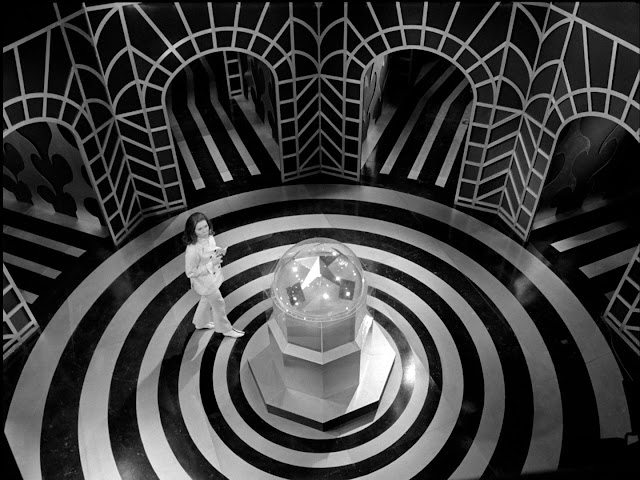
The script has striking concepts, shifting though time zones, bookended by grossly unfair trials that ignore the Doctor’s defence and sentence him to death, one by 1917 officers and the other by the Time Lords; the design is equally striking, with grimly realistic war settings for the humans and full-on ’60s op-art craziness in concentric rings for The Interrogation Room That Jack Built. Despite my love of geometric monochrome patterns, though, I’d love to see the uncropped photos of the giant arrows in the aliens’ War Room in colour – I’ve seen a cut-down shot, and they look terrific… And, of course, having made you think the aliens and the War Chief were the ‘big bad’ throughout, it ends by establishing the Time Lords as the most effective villains the series has had so far, ruthless self-styled gods who exercise absolute power but answer to no-one.
I’ve not yet seen the DVDs, but the three-disc set boasts far more special features than usual. Every episode has a full commentary – expect Terrance to be very bitchy – and production notes, but there are also documentaries on making this story, on making the series in black and white, comparing the story’s locations now and then (a visit to Brighton’s glamorous tip), features on the composer, the make-up designer, the political and military history, the Doctor’s regenerations… I’m particularly keen to see what they make of the Second Doctor’s comic-trip adventures (Quarks!) and, in the first of a new series of pieces on the Target Doctor Who books, of the novelisations written by The War Games’ co-author Malcolm Hulke, probably the most consistently impressive and inventive of Target authors.
If all that hasn’t convinced you, there’s a particularly fine ‘Coming Soon’ trailer on last week’s DVD release, Delta and the Bannermen; if you don’t have that, it’s only up on YouTube so far in a rather distracting aspect ratio. Worth a look, though, for compressing ten episodes into a minute and a half with a clear narrative, fast editing, and a great ‘thoom’ to end with.
The War Games is released on DVD on Monday the 6th of July.
Incidentally, you might also like to look out for a similarly-named drama made at a similar time, Peter Watkins’ The War Game, an evocation of nuclear war so harrowing the BBC held it back for twenty years, and his earlier drama-documentary, Culloden, which takes one of the same periods The War Games touches on. The BFI brought it out on DVD a few years back, and it’s superb – telling the story of a battle in a reportage style that gives it freshness, immediacy and brutality, a style that Doctor Who’s never yet borrowed on TV; I wonder if the new production team might consider it?
Labels: Alex’s In-Depth Doctor Who, Doctor Who, DVD, DVD Tasters, Patrick Troughton, Reviews
Tuesday, June 23, 2009
I’m Sorry I Haven’t A Cure
“Famous institutions here in Westminster include the old Royal London Hospital, which was recently the subject of restoration work. However, disaster struck when the Homeopathic Wing collapsed – because they used scaffold poles which were just one-millionth the strength of proper scaffolding that actually worked.”You can hear the second show again at noon on Sunday, or of course on the iPlayer’s Listen Again service, but entertaining as the rest of it was, there was something particularly satisfying when Mr Fry urbanely stilettoed those hope-cheating, money-grabbing, health-endangering quacks to whom too many others give a free ride. Looking at previous posts where I’ve touched on them – though I’d recommend Bad Science if you want to read a rigorous, regular and scientifically applied series of repeatable kickings – it seems that Radio 4 is a recurring theme across each of them, too, though I’m usually provoked by the Today Programme (a surprise, I know, dear reader) rather than cheering on such a serious and well-thought-out programme as I’m Sorry I Haven’t A Clue. I have in the past conflated them with David Cameron by suggesting that a “Liberal Conservative” was of a piece with being a Christian Satanist, a carnivorous vegetarian or a scientific alternative medical practitioner, but my favourite piece was after the Medicines and Healthcare Products Regulatory Agency gobsmackingly decided to let homeopathic “remedies” label themselves like proper medicines, but without any of the actual tested evidence that any functional medicine requires:
“I think I have the solution. I’m perfectly happy for homeopathic ‘remedies’ to carry writing in which they boast of their effect. The text should just be strictly set at one-millionth the size of that on proper medicines. If the theory of homeopathy is true, that should make the advertising far more effective, and everyone will be happy.”
Labels: Comedy, Quackery, Radio, Stephen Fry, Stupid Ideas
Speakers, BBC Hacks, Ming and Doctor Who on Radio 4
Yesterday, I know everyone throughout the land was glued to the various forms of BBC news to find out who was going to be the new Speaker – well, a few dozen of us, anyway – and though the last round was in some ways less exciting than the others, an almighty sigh of relief already having gone up that ‘favourite’ Margaret Beckett had polled disastrously lower than predicted and was out of the running, I was still moderately pleased that John Bercow won. As I wrote yesterday, I’m not a big fan of the man… But, given that I was relatively pro three of the possible Speakers (the one I’d probably have voted for first, as predicted, bombed) and dead against six of the candidates, he at least was the one left in the middle that I was wary of but not implacably opposed to, so by default he’d have been my fourth choice.
For once, the aftermath of something in Parliament was more infuriating than the vote itself. Gordon Brown and Call-Me-Dave Cameron both made very House of Commons speeches: amusing in the way that after-dinner speakers who’ve never done it before are, lavishing praise and the odd barb (echoing each other in their nature, too), full of insincerity and the traditional Thing. Nick Clegg, I was relieved to hear, got a frostier reception by choosing not to be ‘a good House of Commons man’, instead focusing entirely not on appealing to MPs’ traditions or hurt feelings and instead on the need for reform – and how Speaker Bercow would have a fight on his hands, because the Commons isn’t naturally inclined that way.
But while the BBC’s online coverage included more from Nick from the other two – because it’s easier to quote something with a point than waffle – naturally the TV news had the other two… But not a word from him, because now they’re no longer bound by election laws of fair coverage, we don’t exist again. Still worse was Nick ‘Mate of Dave’ Robinson, who gave what was even for him an egregiously biased report straight from Conservative Central Office. It was all about how the poor Tories will have trouble with this ‘unknown’ Speaker and he’ll have to work hard to get them to like him. Not a word, as you may have expected, about the key difference between John Bercow and Sir George Young – about a reformer defeating a traditionalist, still less about him doing it by a reasonably large majority across all parties (a majority much bigger than anyone had predicted, suggesting quite a lot of Tories weren’t telling the truth about their votes). And if a Tory Government does come, an independent-minded Tory sounds a pretty good choice for Speaker, rather than a down-the-line well-behaved one, doesn’t it?
This morning’s Today Programme went one better. Not only was Nick ‘Mate of Dave’ Robinson giving it the same old schtick, but the programme’s prime slot just after 8.10 in the morning was given to Nadine Dorries. Nadine Dorries?! The minor Tory MP with a relentless drive for self-publicity, the one who’s always lying, cheating, being found guilty and then lying again that she’s been completely exonerated? The one colloquially known as “Mad Nad”? Yes, for some reason, the BBC thought she was the most important politician in the land this morning, spewing out the unrelenting and embittered poison of a very bad loser, and every time we heard her say “This is a factual statement,” the words ‘Honking great falsehood’ may as well have appeared in neon letters a metre high above our radio (hilariously, she called the election of an independent-minded member of her own party with a record of calling for change being elected instead of an anti-reform Etonian baronet who was deeply culpable in getting Parliament into that mess “sticking two fingers up at the British public”. Ms Dorries, l’État c’est ne pas toi). They didn’t even ask her whether her furious vitriol against Mr Bercow was anything to do with him being the main Tory speaker against her (losing) proposals to slash women’s abortion rights, which you might think would occur to a journalist doing their job. Then, for political balance, they had Alan Duncan – a Tory, half-defending a Tory, against a Tory. Good grief. Followed by Nick ‘Mate of Dave’ Robinson – a Tory, commenting from a Tory briefing on a Tory who was half-defending a Tory against a Tory.
It’s good to know the BBC represent views all across the political spectrums.
Hopefully, then, my faith in the channel will be rekindled at 11 this morning, when Robert Orchard is due to tell “the story of Sir Menzies Campbell’s battle to shake off media claims that he was too old for the job as leader of the Liberal Democrats. Robert asks how far it is acceptable for journalists to poke fun at someone on the grounds of age?” Well, better late than never, I suppose; apparently it takes about a year and a half to produce journalists’ crocodile tears (see the section “Leadership and the Media” in this piece from after the media forced Ming out, and try to ignore the rest). Actually, The Age of Ming might have me shouting at the radio as well…
Thank goodness, then, for something that should be really worth listening to. The Age of Ming is followed at 11.30am by On the Outside it Looked Like an Old Fashioned Police Box. Here’s what the Radio Times has to say:
“Back in the days before VHS, let alone DVD, the Doctor Who novelisations were the only way a fan could commit the Time Lord’s adventures to memory [mostly right, but have they not heard of nightmares?]. With a child’s big-budget imagination filling in for wobbly sets and monsters, the books became a bestselling phenomenon for publisher Target. Here, Mark Gatiss wallows in some paperback nostalgia as he pays tribute to such authors as Terrance Dicks, Malcolm Hulke and Philip Hinchcliffe [surely Ian Marter] - writers who taught many (thanks to the Who house style) the meaning of the words “capacious”, “crotchety” and “bohemian”, and ended up shaping a whole generation of young readers.”I learned to read on Target Books, and have written reviews both of whole bunches at a time and individual stories, so I’ll certainly be glued to the set and hoping they don’t make a mess of it. As BBC Audiobooks have now started putting out complete readings on CD – among the best releases so far are Doctor Who and the Doomsday Weapon, Doctor Who and the Pyramids of Mars, Doctor Who and the Auton Invasion, Doctor Who and the Cave Monsters, Anneke Wills’ reading of my first ever book, and the rather lovely three-book boxed set Travels in Time and Space – I hope to hear clips of some of those readings coming up in the programme…
For your other viewing pleasure, you might like to try tuning in to ITV4 today at 10.50am – or 2.55 this afternoon, it’s the same episode – for The Prisoner in Dance of the Dead, arguably the best of the series. In some ways, it’s a good one for beginners; by our reckoning, despite always being broadcast eighth, in the running order that makes the most sense (key word: “most”) it’s the second one. On the other hand, it’s one of the barking mad ones, though some way from the most barking mad (key word…).
Patrick McGoohan is terrific in it, but the show’s stolen by Mary Morris, by a long way my favourite Number 2: small, elfin, but utterly dominant – one of the few who gives the impression she knows what’s actually going on rather than just being a jumped-up prisoner herself. You’ll get brain control, disillusioned spies, spooky cats, flirty maids and washed-up bodies on the beach… Then it gets stranger. The climax involves a change of identity for the body, Number 6 unwittingly adopting his own fancy dress, and a carnival that becomes a court staged as a cabaret, featuring a grotesque twist and ending in mob hysteria. It’s a surreal and high-concept episode, teetering on but not quite yet completely mad. That it’s played with such conviction by such superb actors makes it all rather threatening, and compelling fun. It’s even got music from The Tomb of the Cybermen in it, too.
Labels: Bigotry, Books, British Politics, Conservatives, Doctor Who, History, Nick Clegg, Radio, The Prisoner, The Today Programme
Monday, June 22, 2009
Are You Speaking To Me?
The short answer is, it appears, that neither Labour nor the Tories give a toss about reform, openness or even making the House of Commons look a bit better, and have instead seized on three priorities: find someone who’ll protect their interests against the nasty world outside that’s been mean to them; stick two fingers up at each other across the chamber; and stick two fingers up at the voters.
Even this Parliament deserves better.
The one hope, and it’s incredible that I find myself writing this, is another dose of secrecy slaps onto the process that means that no-one quite knows if the old Labour-Tory stitch-up is actually going to work this time. I’m very wary indeed of a secret ballot within Parliament; generally, MPs should be held to account for how they vote on our behalf. Let’s see how it works on this one type of vote, though. No doubt if they end up picking someone good, I’ll say it’s a vindication of a system that defeats the whips as I predicted all along, and if they end up picking
Liberal Democrat Leader Nick Clegg has called for radical change and an end to the establishment domination of Parliament, telling Andrew Marr:
“I want to see a Speaker who transforms the role from the traditional role, which is as a defender of the status quo – almost a shop steward of the rights and privileges of MPs – into a people’s Speaker, into a Speaker who opens up Parliament, turns it from this Nineteenth Century institution into a modern, transparent, open, publicly accessible Twenty-First Century Parliament.”And I agree with every word except one. “People’s” sounds like a Twentieth Century communist dictatorship or, almost as bad and slightly more sickening, Tony Blair. I wish Nick would give up the habit. Anyway, I back Nick’s call. But then, Nick called for a massive programme of reform that could take place over a hundred days, and after 22 days, Parliament’s done bugger all. So I suspect that bugger all will flow naturally into Buggins’ Turn.
I wrote a few weeks ago that the new Speaker shouldn’t be some old grandee. There is no worse time in British history for Parliamentary tradition and Buggins’ Turn to be followed. I said it should be someone with a proven track record of calling for and voting for reform before it was fashionable, if Parliament’s to crawl back to any sort of credibility at all. I suggested (much as I dislike and disagree with him) Frank Field as someone who does seem to have credibility with a lot of the media, which might help rebuild some trust in democracy. For me, the perception of a person who wasn’t part of the establishment and could command wide respect as a reformer was even more important than the action of reform itself (which will take much longer and will get far less press attention, so it’s vital to make a simple, visible statement by picking someone who embodies reform).
Well, stuff that, as no-one fitting the bill has gone for the job.
So what’s left? Ten people, five of them with knighthoods. Good grief. It’s not that I’m against knighthoods per se – well, I might be, actually, but that’s not the point – but can you think of a better way to say ‘we’re all out of touch and doing it the old way’? And there’s the fact that gongs are usually handed out for long service; where a reformer should ideally be someone who’s been an MP for no more than two or three Parliaments, Sir Anything is likely to have gone hopelessly native. No knights, please. What could be worse? Only a timeserving government minister who’s been deeply partisan for as long as I’ve been alive and wants the job as a pay-off for recently being sacked…
So What’s the Uninspiring Choice On Offer?
I’m deeply suspicious of the Speakership going to Labour for the third time in a row. It smacks too much of the Labour Government trying to control Parliament from beyond the grave. But I’m wary of a Tory, too. The most likely outcome of the next General Election at the moment seems like a Conservative government; the new Speaker should be able to spur on Parliament to hold them to account, not hold their dinner jackets. And I get downright frosty when people always suggest a Liberal Democrat for an ‘apolitical’ position, because frankly being in third place for ninety years means you have to have a lot more backbone in what you fight for than MPs who coast along with whoever happens to be winning at the time. Of course, it would be absurd to have an SNP or Plaid MP who doesn’t believe in the Westminster Parliament anyway, and as for the Northern Irish parties… Independents get my goat, too. Egomaniacs with a free ride.
Er, I guess that means I’ll just have to look at the people up for the job rather than analysing which party would be best for the place.
Margaret Beckett
Oh, please, no. Anyone but that. And I don’t think there’s room in even one of my articles for all the many reasons why. First and foremost, she is the single most partisan and tribal candidate for the job. She is a creature of the Labour Party through and through – long a spokesperson, a minister in many departments, combining bitter arrogance and thoroughly undistinguished service in all of them. Can you remember a single thing she’s done, as opposed to what she’s been? Oh, yes: as Foreign Secretary, she was Tony Blair’s liar-in-chief for the Iraq War. She was even Labour’s Deputy Leader and then interim Leader – hardly qualifying her as a referee. And after all that, she was still given the sack a few weeks ago, so it’s difficult not to see her going for Speaker as just a consolation to keep her in the highly-paid style to which she’s become accustomed, particularly now that her massive and roundly jeered-at expenses for gardening are unlikely to be upheld (some of them, for hanging baskets, tubs and planters, took the piss so much that even the Parliamentary Fees Office rejected them).
If all that wasn’t off-putting enough, she’s the only candidate for Speaker who’s refused to back several key reforms – such as letting MPs choose Select Committee Chairs, rather than the government doing it – and the Labour Whips (with help from the Conservatives) are blatantly twisting arms on her behalf as the anti-reform candidate. They’re relying on her record and manifesto of the executive controlling Parliament, as it long has. If all that doesn’t convince you that she’s by far the worst of a bad bunch, remember her performance on Question Time just after the expenses scandal started breaking? The worst reception I’ve ever seen, as the audience booed, hissed and jeered and she sneered, lectured and told them off in return. In every conceivable way, she just didn’t get it. If she’s elected Speaker, expect those clips to be all over the news, and the public’s view of the House of Commons to sink even lower than the incredible low it’s at now.
John Bercow
Well, what to say. In theory, he’s the best-placed ‘reform’ candidate; he might actually shake things up. He also seems to understand that he needs to open communication with the public again. On the down side, he appears to have most support among Labour MPs who don’t actually like him but know that his fellow Tories loathe him, as they have ever since he lost his Tory front bench position for voting for gay equality legislation. That might endear him in a small way to me, but it’s no way to build credibility across the aisle. Plus, he’s been so obviously gagging for the job for years, which makes my eyes narrow; like Michael Martin, he wouldn’t so much have to be pulled to the chair as peeled away from it. Besides, my one encounter with him was stunningly unimpressive. In 1997, I was the youngest candidate for any party standing in the region (however you count it; for short, ‘the bit above London and before the Midlands’) and was called on to do a lot of media and other debates around Hertfordshire, Bedfordshire, Buckinghamshire and so on. I debated against him at a youth rally in Milton Keynes when he was a hopeful Parliamentary candidate (admittedly, with a lot more reason to be hopeful than I did!), and I went along knowing his record as a near-fascist former Tory youth leader, a barking mad right-wing firebrand. Yes, I was pretty much expecting the anti-me. Instead, he was one of the most boring and out of touch speakers I’ve ever been put up against. Ever since, he’s seemed to me to have gone from firebrand to vacuum.
Sir George Young
Oh, look, a grandee. Huzzah. Apparently the other ‘favourite’, he’s the current Chairman of the Standards and Privileges Committee – yes, the one that’s fucked up so appallingly. Like the Conservative London Mayor and Conservative putative Prime Minister, this Conservative putative Speaker went to Eton. In isolation, that’s no reason to criticise any of them, but put together, you do wonder if the country’s top political jobs can’t find a wider talent (or indeed gene) pool. On the plus side, he’s one of only four candidates to go public about their twelve sponsors (refusing even to be open about who’s backing you doesn’t bode well for a commitment to transparency). The ‘carry on as you are’ continuity candidate. Oh dear.
Sir Alan Beith
Here’s the other candidate that I’ve met – quite often, in this case, and we’ve always got on quite well, despite my discombobulating him more than once in our years together on the Liberal Democrats’ Federal Policy Committee with my rather different worldview. He’s a genuine reformer, a fair and nice man, and one of only four candidates to go public about their twelve sponsors. The trouble with Alan is that only his mild manner prevents him from looking like the embodiment of the establishment (though, having sat on committees with him, he does have some steel to him – I don’t want all this “nice” and “mild” to add up to Sir Humphrey’s famously undermining praise, “Ah, the lay preacher!” Although Alan is, in fact, a lay preacher). He’s been in Parliament since the year after I was born, and I still remember Steve Bell’s 1992 cartoon of him as “Alan Beith – in leather!” for its hilarious absurdity. I can’t quite see Alan capturing the public imagination. He also came under fire for splitting his expenses with his wife, Diana Maddock, a peer. As far as I can make out, they didn’t claim for anything dodgy between them, but it looks dubious. And people will make up their minds on the new Speaker unfairly quickly. Were I in Parliament, I’d consider voting for him.
Ann Widdecombe
No, seriously? A partisan bruiser with a reputation for being slightly unhinged isn’t the most obvious choice for Speaker, but in her favour, she might capture the public (meaning press) imagination – or blow it to pieces. She’s also one of only four candidates to go public about their twelve sponsors. The down side, other than anyone who’s ever heard her speak on any issue – I’ve never met her, but once had a letter printed in a national newspaper ridiculing her stance on cannabis when Tory Shadow Home Secretary – is that although she poses as a fearless battler for ordinary people, her record on reform is the most shameful of any of the potential Speakers, persistently voting in Parliament to prevent any of us finding out about MPs’ expense. She’s also only standing to be Speaker until the end of this Parliament. What’s the point of that? Sounds to me like her USP is ‘vote for a media personality to get you through this mess while everyone’s glaring at you, then you can vote for the usual stitch-up in a year’s time when all the fuss has died down’.
Parmjit Dhanda
Another former minister, and possibly one looking to save his seat, his track record’s distinctly unimpressive. However, he’s the youngest candidate and the only one of Asian extraction, and has made some decent noises (nothing definite, you understand) about standing on a reform platform, so he has the capability to make an instant stamp as someone different, and that’s needed. Were I in Parliament, I might consider voting for him.
Richard Shepherd
Despite having been an MP for thirty years, he’s the most credible member of the Tory awkward squad, with a solid commitment to civil liberties and reform, and was one of the first to break ranks and criticise the former Speaker. Independent-minded, clean, an impeccable record on freedom of information… It’s no surprise that he’s thought to have no chance of getting it, nor that, were I in Parliament, he’s probably the candidate I’d be most likely to vote for.
Sir Michael Lord
It’s not a felicitous name if you want to avoid being seen as part of the establishment, is it? He might just be the most establishment candidate standing. This does not endear him to me.
Sir Patrick Cormack
And if Sir Michael isn’t the most establishment candidate standing, Sir Patrick probably is. He’s been in Parliament since 1352 and positions himself as a traditionalist. Save us.
Sir Alan Haselhurst
This knight of the Shires isn’t some anonymous grandee – no sir. He’s a grandee that everyone remembers for pocketing a scandalous £142,119 second homes allowances… Without a mortgage to pay. Plus, he’s been Deputy Speaker for the last 382 years, and thus utterly complicit in the whole rotten system that this election is meant to sweep away. Even though he’s been one of only four candidates to go public about their twelve sponsors, that’s too little change, too late. By far the most gobsmackingly unbelievable candidate. What does he think he’s doing?
The answer to my question, then, is that none of them are really speaking to me, though three would probably be all right, several others look pretty bad and the one the bookies have most likely to win would be an utter disaster. Business as usual, then.
In Other News…
I noticed just before I started writing this that Stephen is also horrified at the thought of Margaret Beckett’s election. A chap of excellent instincts.
If you’re tired of reading about Speaker nonsense, my old friend “Costigan Quist”, a far more radical Liberal than his ‘real-life’ persona suggests, has a typically brilliant piece about the only people who are more pathetically incapable of doing anything in politics than politicians, who at least get off their arses and try – yes, the public are to blame. But will Sir Alan still be able to blog if he’s elected Speaker (damn, I’ve outed him!)?
And finally, have you heard the interview where the newly elected populist bigot Mayor of Doncaster is revealed to be an utter and total fuckwit without the faintest clue what he’s doing? Just a shame that interview didn’t go out before the election, eh…
Update: It appears that opposition to Margaret Beckett is not an unusual phenomenon amongst Liberal Democrats. Except for Mark Littlewood on Liberal Vision, who’d rather have a socialist than a Tory – is he feeling all right? And thanks, Anders!
Today, I have been consoling myself by listening to George Harrison’s greatest hits, Let It Roll. Ahhhhh. Particularly Cheer Down, which is fab and which I was the sole person in the UK to buy as a single when it

Labels: British Politics, Conservatives, Corruption, Labour, Liberal Democrats, Music, Stupid Ideas, The Golden Dozen
Friday, June 19, 2009
Labour Conspiracy Waves Its Manhood At A Fluffy Elephant
Aaron Murin-Heath is the deputy editor of Labour Conspiracy, one of the biggest blogs in the land, but is clearly very threatened by an eight-year-old stuffed toy with a relatively low profile, despite constantly using terms that show us what a “man” he is and how “bitching” and effeminate people who complain are. Before complaining, bitching, making a mealy-mouthed half-apology, carrying on doing what he’d ‘apologised’ for, then announcing on comprehensively losing the argument that this was his last post, so he could have the last word and none of the others count, ner-ner-ner-ner-ner.
From all this you can tell that, unlike Millennium (who is only eight), Mr Murin-Heath is a grown-up.
Although Mr Murin-Heath is one of those on Labour Conspiracy who isn’t tribally Labour, and who claims to have Liberal views – I’ve not read any from him, but I have asked in reply if he might perhaps point us towards some – my view of the site has been made much more negative by his arguments (which are, essentially, that Liberal Democrats are both too meek and too aggressive, that complaining about his site is bad but countering his complaints to a little blog is mean, and that because he doesn’t support the Labour Party we should ignore the massive Labour bias of the site he runs). Still, it proves that it’s not just the more well-meaning of the tribally Labour people who genuinely don’t understand why Liberals are sceptical of this project that appropriates our name to make us another party’s foot-soldiers. While I’m sure many people involved in Labour Conspiracy see it as a way to neutralise and take over political opponents, I’m also sure that less cynical but more deluded Labour people think saying ‘hey, let’s all get together and fight the Tories, so mostly back Labour’ is pluralism.
I recommend that you read Millennium’s account of a Labour Conspiracy event a year ago, with which I generally agree and which includes a couple of remarks from me (I was sitting next to him).
I recommend you then read Millennium’s latest article, the one which has caused all the fuss. And perhaps recommend it to Lib Dem Voice’s Golden Dozen, as I shall.
In addition, though, I’d like you to read one of my replies to Mr Murin-Heath, which sums up what I think of his site. I’ve replied several times on a thread that’s really got quite long now and may well keep growing, so you can be forgiven for not trawling through the whole thing. This, however, is one I prepared earlier:
I’m feeling awkward in posting now, given that you’ve just put up a half-apology, Aaron (or ‘Human’, given your address to Millennium)… But as your apology appears to criticise Millennium for not taking into account your private correspondence [NB Not to Millennium, but within the Labour Conspiracy intimate circle!] and, after repeatedly laying into him, you ask for mercy, making it not the most ‘manful’ (as you might put it) apology in the world, I’ll go ahead anyway. Feel free to shoot back, if you can look up from your foot.
I think Millennium hit it on the nail when he talked about your site’s “rude children”. I’m happy to engage with people on the issues, or even over campaigning – where, as the Liberal Democrats always work harder than other parties, complaints usually boil down to ‘It’s not fair! We should be able to sit down and have votes fall into our laps!’ – but when faced with an irrational stream of abuse that says, ‘Waaahhh! I lost so you smell!’ I tend to walk away. In real life, that’s what I’d do unless I was a candidate and had to argue with even abusive idiots (and I have been a candidate, and I have done). Online, I just think, ‘site’s full of trolls. Avoid’.
I, too, went along to the “Liberal Conspiracy” event that involved us proles being addressed from the leaders at the front. Being in an upside-down-pyramid-shaped theatre didn’t mean it wasn’t top-down. I gave it a chance, and the nibbles were good, but it felt almost completely like a ‘you, the masses, will be told how to save the Labour Party’ rally. I had my fill of student socialists a decade or two ago, thanks.
You appear to be attacking Liberal Democrats on the grounds that ‘you should be authoritarian entryists and take over our site’. Sounds like every student socialist I ever knew. Fits right in with the Labour Party – just isn’t a Liberal way of thinking. Though I can think of a good reason why we might feel we had the right to a takeover…
Right from the start, “Liberal Conspiracy” has had an overwhelming – not, I accept, universal, but by a massive majority – sense that the Labour Party must be saved, that it’s basically nice, that it’s the leader of all the parties except the Tories, and that the Tories are the worst things ever (and therefore that the Labour Party is very much better). I disagree, absolutely, with those underlying assumptions. You want to know why Liberals call your site “Labour Conspiracy”? Because it’s an overwhelmingly pro-Labour project that’s deliberately nicked our name, to co-opt us with lip service rather than deeds or ideas.
So I’ll not call you “Liberal Conspiracy,” thanks. Because the vast majority of you are nothing like Liberals, and only get Liberals backs up by what looks like the latest in a very, very long run of Labour co-options of other parties to the Labour cause. It reads like yet another Labour Conspiracy to take over the Liberals, and while that might be right up your cul-de-sac, it’s not where I want to go.
PS The Lady Mark also has an excellent post regarding Labour Conspiracy this week, and – even before Mr Murin-Heath’s willy-waving at Millennium this afternoon – Orangejan captures their sexual politics brilliantly in one of the comments.
Labels: Blogs, Labour, Liberal Democrats
Monday, June 08, 2009
Doctor Who Magazine’s Golden Treasure
Back in 1973, years before Doctor Who Magazine began, before any of the mass of guidebooks (still less websites) naming every Doctor Who story were published, the Radio Times celebrated ten years of the series with a special glossy full-colour magazine, back when the Radio Times itself was printed on loo-roll. It boasted a mini-guide to every story (sometimes accurate), plans to build your own Dalek (with the measurements wrong), a Dalek story by Terry Nation (who decided it didn’t count, so used the same idea for a Blake’s 7 episode) and, above all, it was packed with thrilling photos, both from the stories themselves and specially staged ones with many of the actors who’d played the Doctor’s companions. I probably wasn’t walking yet by then, still less watching Doctor Who or arguing with other fans, but a few years later a family friend gave me the slightly battered copy he’d bought at the time, and it instantly became (and has remained) one of my most treasured possessions. For many years, it was a window into the series’ prehistory – anything from before I started watching was, of course, ancient, and anything from before I was born practically mythological – that you simply couldn’t get in any other way. It still looks terrific today, and is so iconic that drawing a variation of the cover (starring the two of us) was the natural choice for Richard and my tenth anniversary.
So in terms of affection and excitement, and with well over 400 Doctor Who Magazines since then, the bar is set pretty high. Well, 200 Golden Moments pretty much clears it. It’s the ideal celebration, and if I were you I’d go out and buy a copy before they all sell out. Though I’m half-American I’m incapable of a convincing American accent, so it’s a good job I’m only writing a booming advertiser’s voice: ‘If you only buy one Doctor Who magazine, make it this one’.
I love reading – and writing – in-depth articles on Doctor Who, something thought-provoking and with a bit of punch. I love laughing at the bits that don’t work (though – as with any tribe – only with another Who-lover, defending the series against all comers from ‘outside’). And I love watching some stories an awful lot more than I love watching certain others. But, above all, I love Doctor Who, and sometimes it’s a little wearing when all a particular fan or book or site seems to do is be negative. Four or five years ago, Richard and I were reading a particularly in-depth, insightful and comprehensive book on the series and greatly enjoying its ideas, its turns of phrase, and ganging up on it together when we thought it had got something hilariously wrong. But although it and its companions are probably the best set of books ever written on the series, we often felt that at times they lost sight of why they were into Doctor Who in the first place. So from then on, when Richard and I watch Who together, even a story we really don’t think much of, we’ve always tried to ask that question that was missing from these books – why is this story brilliant? Whether it’s a chorus of praise or just a saving grace, the idea of the series is so magnificent that every part of it has something worth treasuring. And that’s why I love this new special: at last, someone’s produced the very thing I want to read to cheer myself up about any of Doctor Who you care to name.
Why Is This Brilliant?
It’s immensely readable. It’s made up of a couple of hundred little nuggets, all beautifully illustrated, by dozens of different authors in dozens of different styles and finding something memorable for many dozens of different reasons. It focuses on great drama, funny one-liners, special effects wonders, scary cliffhangers, gorgeous music, fantastic acting, long, short, sad, happy, old, new… Like the series itself, each piece is something new. If you know every story, you can look at it through someone else’s eyes; if you’re a more casual watcher, it’s like 200 trailers or bite-sized insights, something that might make you think, ‘Ooh, I’d like to try that one’. You can read it from cover to cover, or back to front, or pop in and out at your leisure – it’s ideal to dip into, and like a particularly good chocolate selection box, you can just take one at a time, or you can swallow 200 at a sitting.
Now, obviously I’m a Doctor Who fan, so naturally I could pick at this. I could point out that, as some stories get more than one “golden moment,” there are actually not 200 but 222 of them here. But what sort of pedant would you have to be not to see that as a bonus? I could complain that when I picked out 46 stories to illustrate Why Doctor Who Is Brilliant last year I roamed across the whole glorious panoply of Doctor Who, from TV to novels to comics to radio plays, and this sets its sights too narrowly to do the whole marvellous concept. But then, I only picked one story from each year, and they’re doing the lot – just how many pages would it take to cover “A Few Thousand Golden Moments”? So, you know, they’ve got it as near to just right as it could ever be. And, like that fabled Tenth Anniversary Special, open it up and it looks gorgeous.
A Peek Inside…
I’m not going to offer a critique of every single piece in there, because – well, obviously, because I don’t want to take up 146 pages (and probably 146 days to write). But I’d like to pull out a little of the best of it, and raise the odd eyebrow. The first thing, of course, is that they haven’t – they can’t have – chosen all the same moments that I would. So with some stories you turn the page to find exactly the famous scene that’s always praised, while with others there’s an iconoclastic focus on something you wouldn’t expect at all, with the one everyone raves about suddenly missing. I set myself to scribble down the half a dozen scenes from the entire series that I thought were the most indispensable, and when I flipped through to check, they had three of them. But, you know, most of the time it’s just as joyous to find yourself looking at a little-thought-of scene in a new light as it is to bask in the comforting glow of something you’ve always ‘known’ was magnificent. And if you’re too upset about your favourite being ignored, Philip MacDonald’s evocative introductions for each Doctor pick out a brace of brilliant moments each sketched in a few words, just a selection of some of the bits they didn’t choose, and chances are you might find it mentioned there anyway.
I’ll take you on a trip through my favourite Doctor, then skip more swiftly through the others. The magazine starts perfectly – the first choice, for the first story, is exactly the one I’d have made, as Ian, Barbara and all of us first enter the TARDIS. I look at my scrawled six and, yes, that’s just about the most indispensable of the lot. And when I wrote the other week about why The Edge of Destruction was brilliant, the moment quoted here is one of the scenes that gripped me, too. We come to the earliest-broadcast story I don’t think too much of and, hurrah, Jonny Morris has gone for exactly the nightmarish moment I always think of as its finest. Matt Michael picks a scene that I wouldn’t for The Sensorites, but captures it beautifully, and links the marvellous William Hartnell all the way to Christopher Eccleston in a flick of a phrase – then his next choice includes the lines I used when, ten years into making political speeches, I first flourished a quotation from Doctor Who to a packed room. Andrew Pixley, known for his learned, detailed archive work, is a revelation, making me smile throughout with sheer, infectious joy, then Gareth Roberts – known for his fine comic writing – leaps in with one of the most searingly dramatic arguments the series has ever known, even if he falls for the Earl of Leicester’s spin-doctoring. Jonny Morris reveals Billy’s lolcats; Nev Fountain thanks the stars that Doctor Who always managed to avoid (sometimes by a whisker) such ghastly sci-fi clichés as the Planet of Women. Paul Cornell shares the “sheer magic” of Billy’s most moving soliloquy; Mark Wright picks out what, if Bill Hartnell was the star of Buffy the Vampire Slayer – what a marvellous, marvellous idea – would be his ‘hero moment’ for the titles. And Patrick Mulkern picks out some eye candy, then later on plays what I’m certain is a Hampstead euphemism. I know where he’s coming from.
Rob Shearman, ah, the lovely Rob Shearman, superb writer, incisive critic, swoops in on just how utterly brave and brilliant was the way they changed the Doctor for the first time. Stuart Manning takes a minor scene from one of my favourite little-known stories to illustrate in a couple of hundred words exactly the ideological point I made in several thousand. Philip MacDonald, in The Tomb of the Cybermen, hits on another of those magic six I’d scribbled down, and makes a lovely case for The Abominable Snowmen – and he’s right, you know. Between them, on one of those stories that get two golden moments, Keith Topping and Jonathan Morris capture exactly the most horribly memorable scenes… Though I’d have been torn in making it three, and added the terrible, fearful, hideous glee that comes in torturing a Cyberman.
Probably the biggest shock in the entire magazine is that a scene so memorable it’s been remade three times in Doctor Who TV, for pop videos and even for Pringles, killer shop window dummies smashing through the high street in Spearhead From Space, is ostentatiously missing as a scene I’d never have thought of takes what everyone would assume was its place. Which is why it’s so perfect that the pull-out quote for the scene which every fan will frown at for being the wrong one is, “Is this someone’s idea of a joke?” Priceless! Then, for the sequel, Scott Handcock makes me see the brilliance in a cliffhanger that, I’ll confess, I’d always thought a bit rubbish. And Dave Owen nails the relationship at the heart of The Three Doctors, while Philip MacDonald treasures a tiny, exquisite moment from the next story along.
After an ad for Big Finish’s Short Trips books, now at the end of the line and flying off at half-price – you know you want to – there’s Tom Baker. Gosh. What a lot of Tom. And every little bit marvellous. There’s a lovely little moment by Paul Vyse from The Sontaran Experiment, then Gary Russell and David A McIntee between then zero in on the central drama of Genesis of the Daleks (even without the scenes I’d have picked – the Doctor and Davros’ philosophical debate for sheer electricity, and Ronson’s screaming death for memories of boyhood bloodlust). But while Gary’s piece nails Davros’ fatal flaw, I have a problem with David’s. Even though (thanks, Jennie) he did vote Lib Dem in the Euros. You see, he’s both absolutely right and dead wrong on the Doctor’s moral quandary over whether to destroy the Daleks. Where David goes wrong is in his shortcut to answering the Doctor’s question, where he rephrases Sarah’s comparison of the Daleks to a virus into “a genetically modified mould in a dodgem car” and that, because of the dehumanising words “genetically modified,” it’s fine to kill them… Which, rather than listening to the Doctor’s argument that this is an intelligent species, ironically takes the Daleks’ side that you can say another form of life isn’t like us, and so destroy it. Where he’s right, and impeccably liberal, is in seeing what’s so important about a hero that asks questions:
“This is a hero, a role model, who, when faced with a difficult decision and unpleasant options thinks about them… The nature of the question, or the answer, doesn’t matter; it’s the concept of asking that’s so fabulous.”Nev Fountain then earns incredible brownie points for pointing out just what an incredible cliffhanger Part One of The Deadly Assassin has – yep, it’s my favourite cliffhanger, and my favourite story. So I’ll ignore the choice he makes for one later story of one of the few scenes in the special I still think’s rotten… Love to Philip MacDonald again, too, for finding a moment in The Face of Evil that says exactly how vitally important Tom Baker could be. Readers who know The Robots of Death well will understand just why it’s disturbing that “David Bailey” writes about it, and hooray for Marcus Hearn, who spots one of the most marvellous things about Robert Holmes’ writing, as well as Kate Orman, who knows exactly why the last Doctor Who story to really, really scare me was so scary.
You can tell I love this period, can’t you? Because I’ll never finish at this rate. I’d better skip most of Tom and tell you just to get the magazine itself, which is much more fun to read, after all. Look out, along the way, for top Gary Russellness on The Invasion of Time, Peter Anghelides hitting one of the tiniest, most perfectly crafted things about The Androids of Tara (albeit making the mistake that everyone makes about the story, and not picking the line I borrowed for a certain blog), Gareth Roberts filling me with enthusiasm for The Power of Kroll, which is no mean feat, and Dave Owen, hurrah, knowing that the music is the most gorgeous thing in City of Death. Plus lots and lots of Jonny Morris (and more for free), who always comes up with something new – even if I don’t think he gives enough credit to the brilliantly talented David Fisher.
Rob Shearman doesn’t write many of the pieces here, but they’re some of the best. He’s spot-on – and, unexpectedly, very funny – for Full Circle, and supplies two brilliant moments for the early Peter Davison era. Also unexpectedly, that period gets perhaps the most impressive run of nuggets in the magazine; if you want quality writing, the middle’s a good place to start. Scott Handcock again sees right into the Master in Castrovalva, Gareth Roberts finds a premonition of death, and Rob, again, takes an opening scene I’d always thought of as perfunctory and shows the unsettling effect it’s there to create. It’s probably the most memorable moment in the magazine for making me see a scene from an entirely new angle. Jonathan Morris gets it right again and again on Snakedance and Frontios, Ian Farrington summons up Sgt Pepper, and Matt Michael has a marvellous moment of childhood terror – a piece of personal memory that even beats Gareth Roberts and Bonnie Langford.
I know David Darlington, but I can assure you he’s not bribed me to say that I loved his celebration of Colin Baker in The Twin Dilemma. Oh, it made me smile. And at the other end of Colin, Cavan Scott picks something way cool. New Grand Mekon of All Doctor Who Steven Moffat writes about Dragonfire; you know, I don’t really agree with him, but he writes it jolly well. And Mark Wright’s dead right on Paradise Towers. I know Joe Lidster a bit, too, and when I saw him on Saturday I really should have told him how perfectly he conjures a moment of The Curse of Fenric. I don’t know James Moran, but I also met him on Saturday and he seemed terribly nice; I should have told him, too, that he was lovely on Survival. Because I knew, of course, it had to be that scene, but I don’t think I’ve ever read anyone evoke it so well. Bless Kate Orman, next, for what she says about kissing, and Dave Owen on just how funny the Master is. He is, you know.
Gosh, only nine paragraphs into the three I meant to write about the magazine itself, and I’m into this century. Yay for Matt Michael on The End of the World; I love it too. There’s Jonathan Blum on Doctor Who making you cry – the story he writes about did for me, as well – and Scott Handcock, on it scaring you all over again. Then David Tennant thunders into Doctorness with a fabulous scene brought to us by Peter Anghelides, and it’s that Jonathan Morris again, not making the choice I’d have made but drawing me into his view of New Earth. And what scene’s a Dalek’s favourite? I’ll let you read it and find out, but it’s brilliant, too. And thank you, Gary, for hitting what might just be my favourite David Tennant moment in one of his finest little stories, while Jason Arnopp picks probably the mesmerising “moment” I’ve watched more than any other from this century’s Who. Though he lifts out seven minutes, and I just can’t stop before I’ve watched the episode’s whole last sixteen. And what could be a better end – to the beginning – than Andrew Pixley making me utterly thrilled when reading about Planet of the Dead?
Go on, go on. Buy it. Their snippets are much better than my snippets about their snippets.
Other Marvellous Moments
The lovely Tom Spilsbury’s Editorial opening the magazine mentions the inspiration for it all, DWM’s 1996 article 20 Moments When You Know You’re Watching the Greatest Television Series Ever Made. That evocation of Doctor Who’s That Certain Something stirred a lot of imaginations at the time, followed by ten more suggested by readers, another ten of the best cliffhangers – bizarrely excluded from the ‘main’ set – and one ‘best moment’ each for the Master and the Cybermen. That’ll be 42, then. Strangely, given that those were DWM’s indispensable moments for the series thirteen years ago, only 19 of them made it into the 222 (the ‘extras’ suggested by readers turn out to be the most successful). Then the flurry of favourite snippets died down until DWM published its list of the series’ greatest deaths last year, and even the top one of those doesn’t make it here. Inspired like many people back in 1996, though, and by my childhood marvelling at clips and comment documentary Whose Doctor Who, I edited together my own 50 favourite scenes – don’t worry, I won’t list them all – of which 20 appear in 200 Golden Moments.
I’m going to finish by writing about just one scene I’d like to pick as a magic moment. In the spirit of the special magazine, it’s finding something absolutely glorious nestling in a story that’s perhaps not one of the best. 40 years ago yesterday, a BBC press conference presented Jon Pertwee as the new Doctor. My feelings about his Doctor have been complicated over the years, and I’d say now that, while I love him, he’s the Doctor I find it most difficult to like. [Slight update: I was getting rather sleepy by this point in the article (having had just two hours’ sleep amidst grumbling at the election results the night before) and entirely forgot that this was the point at which I meant to unmask the identity of the outstanding but aggravating book series about Doctor Who alluded to above, one volume of which inspired my whole ‘Why is this brilliant?’ concept through being detailed, thought-provoking but persistently sour. It is, of course, Lawrence Miles’ and Tat Wood’s About Time collection. By a stroke of serendipity, Tat’s vastly expanded second edition of Volume 3 (covering the Third Doctor, though that’s less of a given than you might think) has just been published, and I started reading it yesterday. I had no idea until I read in that very book, 40 years to the day later, of the date on which Mr Pertwee’s casting had been announced. Then, irresistibly, another anniversary presents itself today, this time serendipitously chiming in with the blue giant spider on the cover of About Time 3…]
Skip forward, and 35 years ago today his Doctor suffered fatal radiation poisoning and regenerated into Tom Baker, at the end of a story that was something of a Pertwee megamix, flourishing many of the era’s greatest strengths and weaknesses. Planet of the Spiders is even one of those few Doctor Who stories which I have major ideological arguments with. With all that, you wouldn’t think I love it, but I do – and a large part of my love for that story, and the love I have for Pertwee’s Doctor too, comes with the climactic scene from 35 years ago today.
Back when I was five years old, I wasn’t allowed to stay up for Melvyn Bragg’s Arena arts special Whose Doctor Who, so my Dad recorded the sound from it on open-reel tape. Though now the whole thing’s easily available on the marvellous The Talons of Weng-Chiang DVD, for several decades I pored over the soundtrack, taking years to identify where some of the clips came from. Among them, though, there were three scenes that I could always identify and which I absolutely adored and always held me spellbound. The one which I hadn’t seen on TV on first transmission (and didn’t until the story was released on VHS in the early ’90s, with a fantastic cover based on this very scene) was taken from the final episode of Planet of the Spiders, a story where the action centres on – as you might guess – giant spiders seeking a blue crystal with the power to expand your mind to an incredible degree. Yes, it was made in 1974, since you ask.
“Now listen to me. Listen. I haven’t got much time left. What you’re trying to do is impossible – if you complete that circuit, the energy will build up and up until it cannot be contained. You will destroy yourself.”At the story’s climax, the Doctor walks into the heart of the Spiders’ domain, facing his fear and the Great One, the huge, demented god-empress of the Spiders. Knowing that even to walk into her crystal-powered cave will kill him, he still goes in and offers her the final crystal in the hope that she’ll leave the humans alone. Maureen Morris voices the Great One in a tour de force of power and madness, confronted by Pertwee’s bravery and desperation. The blazing blue of it all, and the giant spider, socks you in the eyes, but the most striking ‘effect’ aiding this extraordinary face-off is the huge, eerie music. It might just be composer Dudley Simpson’s finest moment, and probably Jon Pertwee’s, too.
What’s so magnificent about this scene isn’t just the performances, or the music underscoring them. It’s that the Doctor sacrifices himself to bring the ultimate villain the crystal – but still begs her not to take it. His desperation isn’t for himself, and his pleading isn’t for himself; it’s initially for the people he’s dying to save, but during this scene it changes to a desperate pleading to save the villain. He holds off actually giving her the crystal out of fear for her – and she uses her mind to snatch it out of her hand, thirsting and aching to impose her will on the entire Universe, believing that the last crystal will give her limitless power. He’s aghast not for the Universe, but because he knows she won’t be able to contain it. He pleads, he protests, and is quite frantic to save her even as she’s crying her triumph. The Doctor with the biggest ego confronts the very personification of ego and, dying, tries desperately to save even an evil megalomaniac. He fails. The Great One’s terrific gloating power becomes agonized screams, and they’re the most chilling sound ever heard in the series.
The giant spider thrills the boy in me, the awesome music makes my spine tingle and the dying screams make the hairs on my neck rise, but what really makes this a golden moment for me is the sheer Doctorishness of Pertwee risking his last minutes of life to save his enemy. He’s heartbreaking.
Cross-posted to Next Time, I Shall Not Be So Lenient, my Doctor Who reviews blog.
Labels: Alex’s In-Depth Doctor Who, Doctor Who, Doctor Who Magazine, Fandom, Jon Pertwee, Reviews, Why Is Doctor Who Brilliant?, William Hartnell
Thursday, June 04, 2009
Vote Liberal Democrat – Tonight
I’ve made a few more suggestions about why to vote Lib Dem here. And here. And there are some other good ones here. And even an endorsement from today’s Independent here. In short, we’re stronger together, weaker apart. But get your skates on.
Labels: European Politics, Liberal Democrats
Monday, June 01, 2009
Reading To Be Cheerful (Part Lots)
Mat’s fabulous and inspiring story is of a teenager in a strict Catholic school in the USA who was frustrated by the school’s long list of banned books. When a friend asked to borrow one of them from her, she started up a secret lending library from her locker, including books such as His Dark Materials trilogy, The Canterbury Tales (which I studied at my not very strict Catholic school), The Divine Comedy, Paradise Lost, The Godfather, Mort, The Hitchhiker’s Guide to the Galaxy, Animal Farm (which I also studied at my not very strict Catholic school) and The Evolution of Man (which I was taught about at my not very strict Catholic school). What a fantastic idea.
When I was a teenager in my not very strict Catholic school, I only stood in the playground and read aloud from Spycatcher, then told anyone in earshot that they were breaking the Official Secrets Act. The book was rubbish, though, and put me off my brief interest in spy non-fiction. Though typing that makes me think not of a book but of Earshot, one of the finest episodes of Buffy the Vampire Slayer and another highly entertaining, intelligent and thought-provoking response to school which was banned for a time.
Now, some comments have suggested that this story of a secret library isn’t true. Who knows? Only the person who first posted it. I assume it happened in the absence of actual facts, but does it really matter if it didn’t? That would make it an inspiring fiction that’s spread across the world to tell people reading’s cool… And that’s a story worth telling, anyway.
The other – and much sillier – book-related piece that I belatedly came across this morning is of something from the 1980s that vies with my Magnus Greel and Mr Sin toys as the most blissfully unsuitable products ever aimed at children. Back in 1983, David Lynch released a famously impenetrable film of a book where all the important conversations take place in italics inside people’s heads (“For he is the Quicksand Hatrack!”). I saw Dune when I was thirteen, and loved its strangeness, but I wouldn’t say I was exactly a mass-market demographic. I wouldn’t have looked at colouring books by then, but I missed out – this Dune Colouring Book is fantastic, and it I'd have enjoyed it enormously at thirteen. Mainly in the same way the article does. Weird creatures uttering arcane threats, glistening pustules and dead bodies… I think the writer and illustrator here knew exactly what they were doing.
Why don’t I get back into bed? Hmm… Maybe when Richard (who’s up now) has gone off to work, and the light’s a bit less bright. In the meantime, I’m knackered but having quite a cheery morning.
* Actually sixty-two years ago today, if you think about it…
Labels: Books, Buffy the Vampire Slayer, Education, Film, Music, Personal
Sunday, May 31, 2009
Liberal Democrats Or UKIP?
The other parties are somewhere in the middle. The Conservatives want to sound as anti-European as they possibly can without actually following the logic of their ranting and getting out – I suspect because, deep down, they realise that leaving the European Union would both destroy the British economy and leave them with no-one to blame, so they’d rather shout abuse than take responsibility. The Tories are even leaving the biggest, most influential group in the European Parliament – where all Europe’s mainstream conservative parties join together to get things done – to form a tiny sect with a Czech party that opposes any action to stop climate change and a Polish party that’s rabidly homophobic and calls President Obama’s election “the end of white man’s civilisation”. And those are the nice ones. The Latvian Fatherland and Freedom Party (clue’s in the name there) have a swastika-like logo and are big fans of the SS. Yes, that SS. No wonder former Conservative ministers are calling Mr Cameron’s plans a “rigid commitment to impotence,” when the modern Conservative Party is even voting to let crooks and murderers go free rather than co-operate to stop crime across borders.
Labour are even less honest, knowing that Europe is good for Britain but too gutless to say so, instead wrapping themselves in the flag and being as vacuous as possible. We got our single Labour leaflet through the other day, which largely consisted of a union flag and very little writing. Until we saw the small Labour logo at the bottom, we assumed it was from the BNP.
Speaking of which, all the other parties are pretty much at one in being rabidly anti-European, so they’re much of a muchness (some bigger liars than others). I hope the polls are right and the BNP are polling too low to win any seats; the only other party that might get anywhere are the Greens, who are likely to keep their existing couple of MEPs but not get anywhere else. And even they, unlike all the mainstream Green Parties in Europe, are on the me-too anti-European bandwagon. I hope they’re being exactly the same as all the other knee-jerk anti-foreigner British parties because they’re cynically trying to get votes, rather than because they actually believe it, but either way, it’s a massive fail on achieving anything. If you want to tackle climate change and protect the environment, you need to work with other countries – pollution doesn’t stop at the Channel. The self-styled “Green Party” talks a good talk, but they don’t do anything about delivery. Only the Liberal Democrats actually want to make the European Union work for real green action.
So, here are the choices.
If you want simply to hit Labour hard, vote Liberal Democrat.
Put simply, most polls are showing that the Liberal Democrats are the party most likely to push Labour into third place. Today’s ICM poll puts us clearly ahead of them. So if you want to give Labour a good kicking, the most effective way is to vote Lib Dem and see us beat Labour in the popular vote. Although I don’t like the top-down nature of the electoral system for the Euro-elections, which gives far too much power to parties and not enough to the people, it does have the advantage that it at least reflects people’s votes for parties more accurately. So while at Westminster we have a two and a half party system in terms of which parties win seats, for the Euro-elections there’s effectively a four and a half party system in terms of who’s got a realistic chance.
Now, though most opinion polls show UKIP on a much lower vote than they got in 2004, there are a couple that put them, rather than the Liberal Democrats, in second place. Assuming for the sake of argument that that’s true, they’re much less worrying to Labour. If Labour are beaten by UKIP, they can say, well, they’re no threat at the General Election, because they’ve never yet won a seat at Westminster (though one MP has left the Tories to join them). But the Liberal Democrats have 63 MPs, winning quite a few seats from Labour at the last General Election, and are an even bigger threat to them next time. Being beaten by the Liberal Democrats – as we’ve done in several local elections in the last few years – leaves Labour with no crumb of comfort.
If you want to get stuck in and make the European Union work, vote Liberal Democrat.
We are stronger together, poorer apart.
The Liberal Democrats are a pro-European party. A lot of the time, we seem like the only pro-European party. And it’s precisely for that reason that we want to make the European Union work better, and work together with a large and influential Liberal group from many countries in the European Parliament. We’ve always called for reform – because we can see the good that Europe can do, it frustrates us when it’s petty, undemocratic or secretive. That’s why for many years we’ve had practical proposals for cutting back waste like the Common Agricultural Policy, for having EU decisions taken by the elected Parliament, not the unelected Commission, and freedom of information at all levels, particularly for the Council of Ministers, where national governments make decisions in secret and then pretend to blame other people. The other parties don’t care about making the EU more open, more democratic, more effective – because they like to campaign against it, and the less well it works, the more they can shift the blame from themselves onto other countries.
In a world of globalisation, the European Union is vital. Not only has it kept the peace amongst all its member states – for the first time in a thousand years – but it’s where the large majority of Britain’s trade takes place. Outside the EU, we’d still have to trade with all the same people… But we’d no longer have any influence on the rules. How mad is that? Countries working together can tackle the global economic crisis, promote free trade, save jobs, make the banks behave – one country on its own simply can’t. They can protect civil liberties, from global corporations and big governments alike. Gangsters, murderers and terrorists can all be dealt with far more effectively in cross-border co-operation, but anti-European parties like the Conservatives have voted to let them all go free rather than work with other countries. And that’s insane. Above all, we need to tackle climate change and other environmental problems, the biggest threat to humanity. And you just can’t do that in one tiny bit of the world. The more we work with other countries, the stronger we push for common standards, the longer our planet will last. Vote Liberal Democrat to get things done.
If you want to stop the world and get off, vote UKIP.
Obviously, the Liberal Democrats and UKIP are united on one issue, which is to have a referendum on whether or not the UK should stay a member of the European Union, though if we get that referendum the two parties will be leading the opposite sides. So if you like the Liberal Democrats on every other issue but want to leave, you can vote for us without worrying. However, if you’re anti-immigrant, socially conservative, don’t believe in climate change and your main political aim is to pull out of the European Union and pull up the drawbridge against all ‘foreigners’, please vote UKIP, because they’re very slightly less horrible than the BNP.
Don’t vote for them, though, if you want to affect European politics in any more constructive way than just to stick two fingers up to the lot. Despite UKIP complaining that too many of Britain’s laws are made in Europe, they never turn up to vote against them, or for them, or to change them… They simply never turn up. Their attendance record at the European Parliament proves that, rather than critics or champions, they’re Britain’s laziest politicians, taking the money but not doing any work on the laws they pretend are so important. UKIP are the party of thieves and layabouts.
If you want cleaner, more open politics, vote Liberal Democrat.
This week, Nick Clegg launched a campaign for ordinary people to take back power and clean up politics. This morning, David Cameron and Gordon Brown have been trying to jump on the bandwagon. The Liberal Democrats have spent years voting for freedom of information and reform in Parliament, but being defeated by Labour and Tory MPs – so it’s no wonder that the Liberal Democrats have the smallest share of MPs of any party being accused by the Torygraph (even if all their facts are right) and over the most minor things. Not one Liberal Democrat MP has been accused of the big frauds, like Labour MPs’ house-flipping, non-existent mortgages or tax-dodging, or of the lavish luxuries, like Tory MPs’ duck islands, servants’ quarters or moats. UKIP’s one MP, on the other hand, was a strong supporter of the corrupt Speaker who blocked reform, voted against freedom of information about MPs’ expenses (all the Lib Dem MPs supported it) and has been accused in the expenses scandal. So 100% of UKIP MPs are dodgy.
In the firestorm engulfing all parties about expenses, UKIP were leading the way. Unfortunately, they weren’t leading the way on openness or cleanness, but on corruption. Only one Conservative MEP’s been shown to be a crook, but two UKIP MEPs have – one even went to prison for fraud. Nigel Farage, the UKIP Leader, boasted last week about pocketing two million pounds in expenses when he thought the microphone was off. UKIP and the Liberal Democrats each had twelve MEPs elected in 2004, and both parties have lost one MEP through defections – in UKIP’s case, the man promoted as their effective leader last time, Robert Kilroy-Silk – but, on the bright side, no Liberal Democrat MEPs have been accused of corruption. Instead, Liberal Democrats have been in the forefront of opening up the European Parliament, publishing their expenses and campaigning for reform. Lib Dem MEP Chris Davies has been called the Parliament’s most unpopular man for constantly whistle-blowing and calling for change. When it came to the big vote in the European Parliament on cutting MEPs’ expenses and forcing them to be open, the Liberal Democrat MEPs voted in favour of change. Most of the Tory and Labour MEPs voted against. And the UKIP MEPs, as usual, didn’t even bother to turn up. So if you want to vote to clean up politics, UKIP are the party of thieves and layabouts. Liberal Democrat MEPs are the ones who’ve actually voted to get things done.
There’s one other issue that you might be considering, and that’s how to stop the racist, lying, loathsome BNP. This is more complicated, but I’ll have a go. The first thing is, I doubt the BNP will get any MEPs. They never have before, even when – like now – Labour has been cynically talking up the BNP in the hope of frightening traditional Labour voters back into the fold. And the media talk up the BNP because ‘ooh, scary fascists’ is a sexier story than talking about European issues. I can’t rule out, though, that some people are lying to the opinion pollsters because they’re too ashamed to say they’ll vote BNP, but will anyway. How can you make it even less likely that they’ll win a seat?
In London and the North-West, two regions where the BNP are relatively strong (but still a long way down), the best party to vote for to stop them is definitely the Liberal Democrats. In other regions of Britain, the best way to judge a tactical vote is to look at last time’s results. Each region elects only a certain number of MEPs, so check who was the last one elected, or the runner-up, then judge how the votes are going. Sometimes the tactical vote might be Labour (though they’re likely to be losing a lot of votes and seats), or Conservative, or even, in some places, UKIP, though that hardly counts as a vote against the far right. In the two examples I mentioned, the Liberal Democrats won two MEPs last time in the North-West. Our second seat there was the last elected, and prevented the BNP from winning a seat last time. So your best bet is to vote Liberal Democrat to stop them again. In London, polls suggest that the Greens will hold their single MEP, but have no chance of getting a second. Liberal Democrat Jonathan Fryer, though, was only 0.06% of Londoners’ votes short of becoming the Lib Dems’ second London MEP last time. So, a Liberal Democrat vote should be able to give him just that tiny bit extra he needs to be elected. Besides, if you really want to make the BNP miserable after the election, can you think of a better way to do it than making sure the MEP that takes the place they were hoping for is from the most internationalist party, the most socially Liberal party, and, in London, an out gay man?
Update: For a more personal and considered post on UKIP, read Andrew’s. But then, as UKIP would point out, I’m the son of an immigrant, so I would say that, wouldn’t I?
Update: Mary Reid has more on the Tories’ new partners in Europe, with Ed Davey’s questions on why they find working more closely with other countries offensive, but are happy to form a club with homophobes, anti-Muslims, climate change deniers and Nazi sympathisers, clearly all of which they find acceptable and congenial, as they’re literally going out of their way to do it.

Labels: British Politics, Conservatives, Corruption, Environment, European Politics, Gay, Labour, Liberal Democrats, Nationalism, Polls, The Golden Dozen, UKIP
As Lib Dems Surge To Second Place, Polls and Papers Say – Vote Lib Dem To Really Hurt Gordon Brown
The Observer comes off the fence today and calls for a positive, not protest, Liberal Democrat vote in the Euro-elections as the best party on the issues:
“There is a pressing need in this country for advocacy of the EU as a good in itself, as opposed to something distasteful that occasionally suits our interests. That view does not preclude criticism of European institutions, but it eschews wrecking tactics against them.After the explosion on MPs’ expenses, columnist Andrew Rawnsley assesses the three parties’ proposals on constitutional reform and voting reform and suggests that the party to trust on changing things is the one that’s always argued for it, rather than the ones who’ve always voted against but suddenly find it fashionable. The Guardian, too, issued slightly half-hearted praise for the Liberal Democrats last week. Jennie has a vivid round-up of today’s Lib Dem news stories.
“Nick Clegg is the most instinctively European leader at Westminster. That is currently a lonely position, but the Lib Dems have a decent record of taking minority stands that are later vindicated. On the environment, on civil liberties and on the mounting debt bubble, the Lib Dems were quietly but consistently ahead of the Westminster curve.
“Likewise on transparency. In 2007, they opposed the Conservative move, tacitly encouraged by Labour, to exempt Parliament from the Freedom of Information Act. The Lib Dems alone took a party line for openness.
“While MPs from all parties are tainted, the parties themselves are not equally guilty. A credible record of support for transparency and for constitutional reform reflects well on Nick Clegg's team.
“This Thursday's vote is being held in a uniquely febrile climate. It should be about Europe; it will be about the expenses scandal. On both counts, it is a moment to reward the principled consistency of the Liberal Democrats.”
Today’s ICM poll for a potential General Election vote puts the Conservative Party at 40% (+1 from the previous poll), the Liberal Democrats surging to 25% (+5), and Labour at their lowest since polling began on 22% (-6). Asking the same people their voting intentions for this week’s Euro-elections – nothing about the county council elections – the figures are Conservative 29% (-1), Liberal Democrat 20% (+2), Labour 17% (-7), Green 11% (+2), UKIP 10% (no change) and BNP 5% (+4). Even for the General Election vote, where there’s far lower support for the minor parties and all of the three main parties are higher, the Liberal Democrats are slightly up on our vote at the last General Election, while Labour have lost nearly half their vote. Yes, I know, it’s almost impossible to believe. Over half of the people who voted Labour last time are still planning to. Where do they find them?
I don’t trust individual opinion polls, though ICM is usually the most reliable pollster, but there’s been a long run of them now showing Labour’s vote disintegrating. The question is, where is it going, and – for actual votes rather than just poring over polls – where would the most effective place be for you to put it? A Populus poll the other day, for example, gave very similar figures, except for putting the Liberal Democrats noticeably lower than other polls and UKIP noticeably higher. We don’t know what the result will be, of course, but in most polls the Lib Dems have been up on their European Election vote four years ago, with UKIP generally down. So it’s possible that either today’s poll or the previous one may be a ‘rogue’ poll (one that’s simply wrong). I would usually expect the Lib Dems to do worse in Euro-elections than in General Elections, with us getting our best votes in local elections, not just because the system enables other parties to make a breakthrough (which hurts each of the three main parties), but simply because Euro-elections are fought on a massive regional basis, and Liberal Democrat bottom-up campaigning is most effective the smaller the area. I’d say hold your breath, but probably more effective to get out campaigning this week, just in case…
Update: I’ve split this article into two and moved the original continuation of it, on the Liberal Democrats versus UKIP, into a piece of its own; I thought it read better that way. It makes more of the case why if you want to hit Labour hard, you should vote Liberal Democrat.

Labels: British Politics, European Politics, Liberal Democrats, Polls, The Golden Dozen
Friday, May 29, 2009
Welcome Karen!
Anyway, she was very good in The Fires of Pompeii, and though we’ll have to wait until next year to see her travelling in the TARDIS, she’s in a photo opp in front of it across all good (and many dreadful) news outlets, including the BBC press release, the Newsround site (with Sister picture), the main BBC news site, The Guardian – again (I’m not on a retainer), and of course the BBC’s special Doctor Who site, which has a different angle with more exciting hair. Coo. Liberal Democrats should not confuse her with Karen Gillard, whom I met in her previous incarnation and got on with jolly well, but for whose autograph I wouldn’t queue.
Unfortunately, Some Doctor Who Fans Can Still Be Gits
I’ve not gone to see what fans are making of this announcement on the Doctor Who Forum, the husk of what was once the go-to site for fans, “Outpost Gallifrey”; not just because it’ll probably be melting, not just because people will have nothing to say except (no doubt) abuse, but because – although my fellow Doctor Who fans are responsible for much that is wonderful in my life, such as many of our friends, our very entertaining night out last night, and above all the one I’m in love with – there are the odd one or two that are intolerant, intolerable and complete pains. I was reminded of this when I caught up with Stuart Douglas’ blog, one I read from time to time, and saw what an utter git the owner of the Doctor Who Forum is being. Good grief. And you thought there was abuse, idiocy, pettiness and a lack of free speech in politics…
Update: Since all this happened, the owner has decided to close the Doctor Who Forum altogether. He’s gradually been stripping it down from the huge site it was a few years ago, so this isn’t a huge surprise, and I suspect it partially explains – though not in any way excuses – his behaviour. If I had decided I was fed up with something and wanted to stop doing it, I might well ignore my in-tray of nasty stuff to deal with on something that I can’t actually be arsed doing any more (er, thinking about it, I may well have done just that in the past). It’s not a big step from that to try and press a magic button to make the whole thing go away. The trouble is, you just can’t do that when your being fed up gives booster rockets for people to be libelled. Yes, responsibility’s a pain, but if you volunteer for it, you have to take it.
*Actually 1930 years ago, if you’re being picky
Labels: Doctor Who, Fandom, Matt Smith
Bill Cash. Bill. Cash. Cash. Bill. We’re Billed For Cash.
A Tory dinosaur of the old school, ironically one of those closest to the Torygraph’s own dark soul – against Europe, gays, modernity and, well, everything, except money – Bill Cash has been paying, by which of course I mean we’ve all been paying on his behalf, for a flat in London owned by his own daughter.
Now, I’ve said before that a member of an MP’s family working for them isn’t necessarily crooked, and that a lot of the time it even gets a better deal for the taxpayer – but that isn’t the point. Because it inevitably looks crooked, it has to stop. The same applies to paying members of their family with our money for their property. If Mr Cash – who sits for a constituency in Staffordshire and so, if he has a home there as he should (I don’t know), would undoubtedly need a second home in London to do his duties there, too – had paid market rent to his daughter for a flat she would otherwise have rented out to a stranger, because he needed a second home in London… Well, that would have been seized on by the Torygraph, but it wouldn’t have been wrong. Sensible on a personal level, very foolish on a political level, but I wouldn’t point the finger.
But what’s this? Bill Cash already has a home in London. One that he owns outright, and that’s in fact closer to the House of Commons than the one he’s renting! But he doesn’t live there… Because he lets his son live there, rent free, and so Bills the rest of us to stump up the Cash for a flat he doesn’t actually need.
And playing musical flats with your family because you want to give a gift to one of them with public money is morally outrageous. That’s the Cash point.
Read John, too, for the best headline on this story.
Dirty Cash – We Don’t Want You
Bill Cash is a clear case of the sort of wrongdoing, a deliberate scam on the taxpayer, that would be tackled by Nick Clegg’s proposal yesterday to let voters recall and kick out crooked MPs.
David Cameron has said that Mr Cash faces “serious questions” over the Bill. You bet he does. But even if Mr Cameron stops him standing as a Conservative MP at the next election, taxpayers will still have to stump up the Cash to foot the Bill (yes, all right, I’ll stop now) to keep him in employment for the next year, or however long it takes for Mr Brown to reach for the vote-handled revolver. Is Mr Cameron going to back Nick’s plan for voters to take down crooks rather than have to wait for one chance every four or five years? Don’t hold your breath.
You may wonder why Mr Cameron seems so down on Bill Cash in particular, when he’s been noticeably gentler with some of the other Tory crooks. When Julie Kirkbride announced yesterday that she would stand down – though she’ll carry on pocketing her constituents’ cash until the election rather than doing the decent thing and going now – Mr Cameron was full of praise for her, and clearly wanted her back. Can he really be so shallow as to prioritise a pretty, media-friendly (until this week) face, while Bill Cash is an ugly old stick with a braying voice? Well… He probably is, yes. But there’s another possibility.
Bill Cash is in many ways the John the Baptist of Mr Cameron’s anti-European Conservative Party, the one that’s about to form a tiny group in the corner of the European Parliament with the nutters, extreme homophobes and parties that say President Obama’s election is “the end of white man’s civilisation”. Mr Cash was ranting on against Europe back when that reasonable, open-minded Mrs Thatcher was in charge and being far too wet and internationalist for his liking. Now the Tory Party’s caught up with Bill Cash’s frothing, what could possibly go wrong for him? Simple. Bill Cash is the John the Baptist of the Tory Party. Imagine how John the Baptist – dirty, smelly, out in the desert, no social graces, ranting and raving and upsetting everyone in sight – would get on with the Pope. Dripping with jewellery. Incredibly rich. Living in a palace. And you no longer have to ask why Bill Cash and David Cameron don’t mix.
Labels: British Politics, Conservatives, Corruption, European Politics, Religion
The Guardian Endorses the Lib Dems – Up To A Point
“The party championed reform when it was unfashionable. The difference is that other parties are now competing to match them. The Lib Dem leader has run a bold pro-European campaign in the current elections (though no one has noticed). The Lib Dems have been ahead of the curve on the three great contemporary crises: climate change, the constitution and the economy.”Yes, today’s leader column starts off slightly grudgingly, but they have to admit that we’ve got it right, often for years. They put down Nick Clegg, to raise him. All that’s fair enough for a newspaper rather than a cheerleader. They praise Nick’s long-term push for Gurkha rights, and how that “was rewarded when MPs passed a Lib Dem motion in the Commons for the first time in decades,” then hesitantly suggest that the Liberal Democrats can compete right across the country: “Labour’s woes allow him to pitch for progressive votes.” As if Labour was progressive. And there’s the rub. Our opportunity doesn’t come simply because Labour are unpopular. It’s because Labour are wrong. But, like an abused cultist, The Guardian still blindly wants to believe.
The editorial concludes by, rightly, suggesting that “voters may not reward the party just for being sensible,” but then finishes on the eternal Guardian put-down note: “the search for the elusive breakthrough is the ancient curse of third-party politics.”
And the reason I eternally curse the Guardian is that they always have that weasel-worded, mealy-mouthed cop-out.
People slag off The Sun and the rest of Mr Murdoch’s stable because, whatever their true views, they swing with the prevailing tide. No-one can pretend their views were ever genuinely in tune with the Labour Party more than the Conservative Party; but Labour have spent the last decade and a half cravenly surrendering to The Sun’s views, and in return The Sun has shone on them (for a limited time only!) because it couldn’t face backing the losers. It is a popular, and populist, paper. So what’s The Guardian’s excuse?
Over and over and over again, they complain that the government is terrible on civil liberties, the environment, poverty, constitutional reform… But, over and over and over again, because that government is a Labour Government, they endorse them at election time because, oh, they’re probably going to win. They’d rather call for their readers to vote tribally for a party that will let them down in every way than take a risk and put their votes where their mouths are. So, Liberal Democrats, enjoy the moment of praise while you can. At the election, I’m willing to bet that they’ll urge support for the bloated corpse of the Labour Party once again, or (if they’re still bumping along at 20% in the polls and so utterly doomed that even The Guardian can see it) perhaps take a punt on that nice Mr Cameron and his text-message democracy veneer of ‘reform’ because, after all, he’ll probably win. But it won’t be the party that actually puts its arse on the line for the issues on which The Guardian merely pontificates.
Come the General Election, when it counts, when we’re once again the only party that stands up for most of the Guardian’s causes, will The Guardian be full of praise – or just full of it?
Update Sunday 31st May: The Guardian’s sister paper The Observer comes off the fence and calls for a positive, not protest, Liberal Democrat vote in the Euro-elections as the best party on the issues. Watch that space for the General Election…

Labels: British Politics, Labour, Liberal Democrats, Newspapers, Nick Clegg, The Golden Dozen
Thursday, May 28, 2009
Go Jo!
They plastered a full page and more on the outrageous slur that she wears make-up. Which she didn’t claim on expenses, and which even the Torygraph didn’t say she did – though the BBC and the Scotsman (clue to the sexual politics in the name there) did claim that even though, er, you can literally see at a glance that’s not true (she handed in a receipt with three items clearly marked as Parliamentary expenses; she explicitly asked only for those; she was only reimbursed for those; but on the same receipt were a few small make-up items she’d paid for with her own money and never asked the taxpayer to give her a penny for). Well smeared, Torygraph.
Why does the Tories’ house newspaper want to damage her with these obvious lies? Because she’s a superb MP. She’s dangerous. Just last week, another newspaper named her as Scotland’s hardest-working MP, and earlier this year the Torygraph themselves praised her for being the MP who led the opposition to the Labour Government’s attempt to exempt MPs and their expenses from freedom of information!
Two political memories spring to mind.
When I was just starting to notice politics, in the early ’80s – about the time that Jo was born – I noticed that all anyone ever said about Shirley Williams was that she was badly dressed, had her hair all over the place, looked a mess… In short, that she was a woman and didn’t look after her appearance, because that was apparently the only thing that mattered. I wondered why I never heard the same about all the men in their horrible ’80s suits that didn’t fit.
You can bet that if Jo dressed badly or didn’t wear make-up, the Torygraph would lead on that, too.
My other memory is first meeting Jo, about ten years ago, at a Lib Dem Youth and Students Conference. We were on different sides in a debate, and it got a bit heated. I had a lot more debating experience, and I won… But she listened, and decided that I’d got it right after all. She’s still grown-up enough to listen to people, but nowadays I suspect I’d lose any debate when she was on the other side. Because not only is she very bright, and usually right, but she’s very much more engaging than my ‘Mr Shouty’ persona.
I hope she wins tonight, as she often does, and sticks it to the Torygraph in the best way possible – by showing that she’s a brilliant MP, and they’re just jealous, sad old men.
Others have written at greater length and with far more detail, evidence and practical tips than I have. For a balanced view, I particularly recommend Caron and Caron again, Jennie, Costigan (on the Guardian jumping on the sexist bandwagon) and James, displaying the Torygraph’s disgusting coverage , and then James again, who makes me seem positively demure but provides an excellent example of his well-deserved reputation as the Lib Dem blogosphere’s tactical nuclear bastard.
Labels: Bigotry, British Politics, Liberal Democrats, Newspapers, Scotland, UKIP
Lock the Bastards In: The 100-Day Lose the Deadweights Programme
- I want the right to sack my MP.
- I want to know MPs can’t be bought off by party donors.
- I want the right to find out what government is doing.
- I want the power of government to be cut down.
- I want my vote to count.
Nick Clegg’s Success – and His Dilemma
Nick Clegg’s had his best few weeks as Liberal Democrat Leader, partly despite and partly because of the firestorm engulfing British politics. But none of it’s been down to suddenly being a fresh face in the last month – it’s all come out of things he and the Liberal Democrats have been saying for a long time, and Nick’s making the most of his chances on them when they come. The Gurkhas? Nick was raising their case at Prime Minister’s Questions a year ago. It took that long to build a campaign and a cross-party consensus. On Parliamentary reform, whether it’s expenses or freedom of information applying to MPs like everyone else, it’s Liberal Democrats who’ve voted for it in Parliament again and again over the years – and Labour and Conservative MPs who stopped it, aided by the Speaker. When why Nick spoke up and forced him out, it was because enough was finally enough, and we couldn’t wait any longer to change things.
Those two sudden successes by the Leader of a relatively small party in Parliament – though the largest third party for eighty years – don’t just show that persistence pays off, though what a relief that it has, and don’t just show that Nick’s developing excellent political judgement and a killer instinct, though he is. Between them, Nick’s two big Parliamentary victories show the dilemma that a radical reformer faces.
Do you build a practical consensus between parties to get things done, as Nick did over the Gurkhas?
Or should you be a radical anti-establishment voice, as Nick was in breaking all convention to bring down a rotten Speaker?
Nick needs to be both, yet building an anti-establishment consensus that the establishment might deliver is a paradox. That’s what’s the extraordinary gamble in his front-page Guardian article today – punching for a target somewhere short of what we’d do on our own, but well ahead of what either Labour or the Tories would do on their own, all based on issues that have some degree of cross-party agreement already. As Millennium says, politics is the art of the possible.
But what could be more appropriate for a Liberal Democrat Leader than punching a hole in the establishment at the moment when it’s most fractured, but in a reasonable and measured way?
Take Back Power! Take Me Now!
You can’t doubt that the political system is splitting apart. Even without the politicians and the media, the British people are hitting it with sticks in rightful fury. And, hitting MPs until they squeak, suddenly other parties are making noises of reform, running to catch up with Nick at Prime Minister’s Questions last week. David Cameron – the Conservative Leader – has this week called for “a massive, sweeping, radical redistribution of power,” which he went on to detail rather less impressively as text-messaging and maybe, maybe not, fixing dates for elections rather than, er, fixing dates for elections. Bless him. But, still, if you want to see how hard a bandwagon’s rolling, look for the biggest bandwagon-jumper in the business (it was such a treat to hear Joanna Lumley on PM last week, when the government finally caved in and gave the Gurkhas the right they deserve, saying that she hadn’t done it without help – that the Lib Dems had been campaigning on it for ages, and then she was also grateful that the Tories had recently jumped on the bandwagon, too). And Labour… Well, Gordon Brown’s frowning silently deep in his bunker and has no ideas, no surprise there, but several of his
Now, Liberal Democrats can hardly believe that the agenda we’ve been banging on about, unloved, for half a century is suddenly sexy (to think, just a year ago the first draft of Make It Happen was dropped for being too revolutionary and disturbing about the system, and went for a reassuring emphasis on the economy instead). We could understandably be hesitant when after decades of sneering at the bookish wallflower at the side of the dance the media and other parties have stepped forward, pulled off her glasses and declared, ‘Why, Miss Constitutional Reform! You’re beautiful!’ We could be shy and standoffish and quite rightly suspicious of the morals and motives of the new suitors. We know they don’t really love reform. Will they toss it all aside when they’ve had their wicked photo opportunity with it?
Nick Clegg’s answer is the bold but dangerous one. ‘I’m gagging for it! Take me now – but show me you mean it, and make an honest political system of me!’
And about time too.
You can see Nick being explicit about what he’s into on TV tonight, or by clicking to follow where he says that, if you get changed out of those old politics you can have a good time with him – I’m sorry, I’ll type that again – you can change politics for good.
If, on the other hand, that’s all a bit racy and you’d like to be wooed, fear not – that old-fashioned, genteel Vince Cable can take you for a turn first.
So What’s the Plan?
You can read what Nick Clegg has to say in today’s Guardian – his main article, the news piece about it, and why David Cameron’s text-messaging democracy won’t do – as well as the full, fully thought-out one hundred day programme on Liberal Democrat Voice. You can sign the petition on the Liberal Democrats’ new Take Power Back website, and harangue your MP – I’ll bet they’re keener to listen right now, when they’re much more frightened of your power than usual – to get serious about changing things. Here’s Nick:
“Real political change is about taking power from those who have hoarded it for themselves, and distributing it to others. So change will only be possible if the vested interests that have benefited from the way things are accept that they can no longer preside over an institutional stitch-up. For generations the Labour and Conservative parties have colluded to keep out competition. They are like a corporate duopoly, setting the rules of the game to maintain dominance. And just like in economics, it's ordinary people who suffer: taken for granted, and deprived of the ability to make different choices to those imposed upon them.
“So instead of long-term consideration of the possibility of tinkering, let us have 100 days of real action: swift, decisive and confident. It really is possible.”
And here are some of the main points:
- I want the right to sack my MP
- I want to know MPs can’t be bought off by party donors
- I want the right to find out what government is doing
- I want the power of government to be cut down
- I want my vote to count
The most important thing is, this could be done. It’s all thought out – it just might happen. All it takes is for MPs to give up their Summer holidays and get to work; once we’ve got a less rotten system, we can have a General Election that you can have more confidence in. The Liberal Democrats aren’t just putting forward all our favourite things. Instead, Nick’s proposals are concrete and simple and have a record of cross-party support and working-out.
So if they don’t happen – you know which parties to be cross with.

Labels: British Politics, Liberal Democrats, Nick Clegg, The Golden Dozen
Wednesday, May 20, 2009
Speaker Rescues Poor Prime Minister Shock
After sliming praise all over the Speaker he’d abandoned, Gordon Brown was asked about his dismal Royal Mail privatisation plans by Lib Dem MP Paul Rowen. Fumbling and stumbling, Mr Brown talked about the pension fund before going on to claim that “they lose five million letters a year” – and the whole House of Commons simply pissed itself. The more he repeated himself, then tried to correct himself by haltingly finding a way to say that they were losing business rather than sticking sackfuls of letters behind hedges, the more they laughed. To the point where the walking dead in the Speaker’s Chair was forced to plead with the Commons not to laugh at the Prime Minister.
Perhaps it was because he’d been so discombobulated that, when David Cameron dug him an obvious bear trap, he obligingly jumped into it.
“This morning, the Prime Minister said that a General Election would bring chaos. What did he mean?”Mr Cameron looked like all his Christmases had come at once, and who could blame him? Yes, the Leader of the Labour Party had just announced that he wasn’t going to call an election because the Tories would win it. He told Mr Brown how rubbish that was and invited him to have another go. The Prime Minister did, and his second, more rambling but less partisan go was much better, but the damage was done. It wasn’t so much an exchange between them that Mr Cameron won as one that Mr Brown lost, outstandingly.
“What would bring chaos would be a Conservative Government!”
Labour MPs then howled at Nick Clegg for bringing down their patron in the Speaker’s Chair. Worth more than a standing ovation at Liberal Democrat Conference, that mixture of fear and fury from your opponents was. Unlike Mr Brown and Mr Cameron, who praised the Speaker to the heights with varying degrees of hypocrisy, Nick thanked the departing Speaker… For his resignation statement yesterday. Honest, to the point, and saying it like it was rather than pretending to regret he’d gone. And then Mr Martin, always one to bear a grudge despite his mates queuing up to say how kind he was – to them, no doubt – didn’t call Nick’s second question, and put him down when he stood up for it. The Walking-Ex-Speaker thought it was funny, and so did his Labour mates; to the rest of us, it just looked like either uber-partisanship or incompetence. If only he’d managed to defend all the worst bits of Parliamentary secrecy and corruption at the same time, that’d have been all three of the reasons why he was the worst Speaker in living memory and had to go.
Nick, incidentally, talked about a a once in a generation chance to change politics for good, calling on the Prime Minister to reform the whole system from top to bottom, and (in that not-called second question) pointing out that our unelected Prime Minister wields power at the head of a Labour Government that less than a quarter of people voted for. Wasn’t it true that a system where so few votes give a Government so much power will always breed arrogance and secrecy? And, guess what, Mr Brown flannelled. Though, interestingly, a backbench Labour MP asked about voting reform as well. Has everyone been reading Mark’s reckonings? And, given that I've linked to him before, it’s not just women he’s not spotted, Jennie!
Labels: British Politics, Conservatives, Corruption, Labour, Liberal Democrats, Nick Clegg
Tuesday, May 19, 2009
Preparing For the Nuclear Option – An Appeal
Before then, can I ask readers for one simple piece of information? Which Liberal Democrat MPs have already said they’re standing down at the next election? Because I have a nuclear option to put to all of those who’re planning to go on, and I want to know all the ones I should write to…
Update: Well, I didn’t follow this up ‘tomorrow’, or the next day… I put it off because I heard that the Federal Executive were going to publish their ‘action’ at the end of the week. Then they turned out to be paltry. So I was rather underenthused – try me again after the Euro-elections (though, as on so many things over expenses, however incredibly, the Tories have stolen the thunder)…
Labels: British Politics, Liberal Democrats
Monday, May 18, 2009
Parliament In Crisis: A Good Day For Nick, But A Lot More Questions To Come
First of all, congratulations to Nick. Yesterday, he really found his voice. I thought he had a ropey week last week; there’s no doubt that the Liberal Democrats were the least dodgy of MPs, but we neither built on nor capitalised on that for most of the time. Several of our MPs were completely open with their expenses, having published them all months ago – why didn’t Nick order all of them to do it, especially as they were coming out anyway? Were the Commons and Lords Parliamentary Parties simply paralysed with fear, or hoping the Torygraph wouldn’t find something? Why didn’t we find the right medium between ‘we’re sorry some MPs took too much’ and ‘come on, a feather duster’s not in the same league as a moat and a flipping great fraud, is it’, when even Jeremy-A-Million-Of-Your-Taxpayers’-Pounds-Paxman could say it? Why did anyone let Ming Campbell go on Question Time and get himself in a complete Eric Pickle? And why didn’t Nick announce in advance of the Torygraph’s Lib Dem revelations that anyone who’d made off with a hefty amount of money they shouldn’t have would be for the high jump – again, we all knew something was coming, yet we’ve been stuck in the embarrassing position of sounding less strict than David Cameron, who seized the initiative paradoxically because moats and mansions and tennis courts were far more corrupt than anything of any Lib Dem MP, and so he could be seen to take harsh action.
Calling for the Speaker to go, though, was exactly the right thing to do, and brave – after all, the Speaker has near-unlimited power to fuck a party over in the Commons. And, despite my utter contempt for Mr Martin, who combines all the worst traits of an exclusive old gentleman’s club chairman and an old restricted-practices trade union shop steward, and who is both rubbish and partisan, Nick was entirely right in sticking to the issue rather than having a go at the Speaker personally. And if you listened to the Today Programme this morning, he was boosted enormously by the grumpy Scottish Labour MP who made wild personal attacks on Nick and everyone who had criticised the Speaker, which probably sounded like a defence to him but sounded to me and I imagine the vast majority of listeners like a corrupt old numpty incriminating the Speaker further with every word.
If they do get rid of him, by the way, who should be the new Speaker? Tradition means Buggins’ Turn, and some old grandee. That is exactly the wrong way to go. Instead, the Liberal Democrats should refuse to support anyone who’s been an MP for more than two or three Parliaments, on the grounds that they’ve gone hopelessly native. Not Ming (fat chance now), not Alan Beith (bless him), not Nick Harvey (have you crawled into a ball of embarrassment when he’s popped up to defend the status quo, too?). It should be someone with a proven track record of calling for and voting for reform before it was fashionable, if Parliament’s to crawl back to any sort of credibility at all. Richard suggested Norman Baker to me this morning (update: and Millennium makes the case for him, as well as having much to say about the whole scandal); I have to admit, he’d be great at it, but I don’t want us to lose one of our best attacking MPs. I don’t know who I’d trust, but – breaking my own rule here within a paragraph – I’ve seen Frank Field’s name being floated about, and though personally I don’t want to see his face on TV even more than it is now, he does seem to have credibility with a lot of the media, and that might help rebuild some trust in democracy, which is the most important thing right now. Plus, it’d stop him bashing immigrants and poor people, so that’d be a bonus.
I wish that a member of the House of Lords I’d have trusted with my life as well as my money, my old friend Conrad Russell, were still alive. With the prospect of the first peers to be excluded from the Lords since the time of Cromwell and the first Speaker to be dragged from his chair since 1690, the brilliant 17th Century historian would be having a field day. And though Conrad and I might have inclined on different ways over the British Civil Wars, we’d agree – or, rather, he made the case and convinced me of it – that the Liberal Democrats’ ‘family history’ begins in the 17th Century, with the desire to limit and oversee arbitrary power. That’s what this is all about – people had the power to do something, so a lot of them did it.
No, They’re Not All On the Take
Of course it’s not every MP, nor every peer, still less every politician. Most of the time I regret that my long-term ill health means I can’t stand for Parliament any more. The last couple of weeks? Well, they’ve been enormously depressing, but they’ve not made me miss it. People long said that all politicians are corrupt – and most those of us in politics have long been frustrated, because it's not true of us and we have to fight against that perception as we pour all our time and effort and, yes, money into trying to get things done. After the last few weeks, everyone just thinks they’ve been proved right all along. It’ll be an absolute bloody nightmare for the thousands of honest, hard-working political activists knocking on doors. I remember all the people on the doorstep who assumed that every politician was wallowing in their riches, and that the second-most aggravating question – after ‘But aren’t you going to come third?’ – was all the people who asked how much I got paid as a Parliamentary candidate. No, not a penny of your money, and not a penny of the party’s, either – if you’re a candidate, all the money goes down an enormous funnel the other way, you stupid prat, and how about getting off your arse and doing something rather than just complaining? As I can say now, given that of course I’m no longer standing.
While I can intellectually understand how much of this happened – that allowances grew far beyond what they should have because wages were held down, in a clever dodge by Mrs Thatcher to massage the figures on MPs’ pay in exactly the same way she brought relatively fit people onto incapacity benefit at a slightly higher rate than if they were classed as unemployed, as a silent deal to keep the unemployment figures down – emotionally I can also say, to every MP that has been on the take, I hate you, because you’ve confirmed every prejudice, brought all the rest of us into disrepute and made the task of changing absolutely anything in this country that much harder.
But though not every MP’s been on the make, the ones who have fit precisely into what Liberal Democrats have been saying for years. Not just that ours are more honest than the others by a mile – though that’s now been proven even if you take some of the Torygraph’s desperate partisan smear jobs to make it look like we’re just as bad at face value – but that this has been boosted by the way the whole corrupt, inward-looking political system works. Liberal Democrats have been arguing for decades for better freedom of information; well, look how the whole system explodes when we get it, even if the Torygraph ironically won’t be free with the information about how they got it, because they were paying crooks. I can't criticise them too much, though, because without their dodgy pay-offs, we’d never have found out about the most crooked of all the widespread practices – “flipping” second home allowances to pay out for house after house in turn.
Liberal Democrats have been arguing for decades that the electoral system isn’t just unfair to people’s party preferences, but doles out safe seats that mean worse MPs – well, look, Mark has analysed the minority of crooked MPs and found that, who’d have thought it, they’re very much more likely to be crooked if they have ultra-safe seats and regard themselves as ‘untouchable’. Costigan reminds us that, with elections via the single transferable vote, we don’t support top-down proportional representation but giving people the choice to sling out an individual MP but still keep their party. You want to know how to make STV ‘sexy’? Tell people to imagine if a General Election were held like that tomorrow! And, tying in with all that (and, hurrah, a party leader agreeing with some of what I said in my first conference speech, half my life ago), Nick yesterday was also calling for MPs that are guilty of misconduct to be subject to recall by their constituents – so, if they don’t like the one they’ve got, they can take it back and get a new one.
That’s all well and good, but it isn’t all. There are still awkward questions to be asked, and some of them are very hard even for Liberal Democrats.
What Awkward Questions Do We Still Need To Ask?
Everyone agrees that the rules so far have been dodgy and need changing. Fine. But the single line most likely to make an ordinary, mild-mannered citizen march on one of their MPs’ homes with a blazing torch is ‘It was within the rules’. No, no, no. Fuck, and indeed, off.
First point: any Liberal Democrat Parliamentarian should be banned by the Chief Whip from using those words.
Second, as any fule kno, it doesn’t matter a toss what the rules were if what you were doing was wrong.
Third, that means we have to consider what to do about what Parliamentarians have done under the existing rules, whether they broke them or kept them, as well as work out what the new rules should be.
I don’t have all the answers, but if there’s one thing Liberalism’s about even more than binding arbitrary power, it’s asking questions. Here are a few we should ask…
So far, a substantial minority of MPs seem to have asked the not-too-difficult questions:
- Is it within the egregiously lax rules?
- If it isn’t, will the Fees Office let me do it anyway?
- Is it blatant fraud?
- Are they all crooks?
So here are a few ideas to focus our minds on what expenses should be permissible in the future, and a yardstick for judging what people have done in the past, finding a happy medium between:
- Does this still enable the MP or peer to do their job properly?
- Does this get the taxpayer value for money?
- Will a typical member of the public want to jab a pitchfork into the MP or peer for it?
Perhaps the central question is:
- Is this taking the piss?
A few quick thoughts of answers would be that MPs from outside of easy travel of Westminster – and thank fuck every Liberal Democrat MP in London refused to take the second homes allowance, while the Tories and Labour kept their snouts down – should certainly have somewhere to stay but, as Nick Clegg has been saying, they shouldn’t be allowed to make any profit from it. Where there is any, that should all go to the taxpayer. Flats or houses, though; it’d be daft to say it has to be hotels only while the House is sitting. Not only are hotels a lot more expensive, but imagine doing your job while moving house a dozen times a year…
What I don’t think the party’s been saying, but which we should have been since the days of Derek Conway, is that no MPs should be allowed to have a member of their family working for them. Sorry, but no. Yes, most of the time it’s probably better value for money, and it’s good for keeping relationships together, but people just won’t stand for it any more. It looks like it stinks even when it’s a good deal, so it has to stop. But, on the good side, at least all this orgy of castigation over MPs’ allowances in the last couple of weeks has had so much to feed on that they’ve not been carrying on that crazy media idea of counting all the MPs’ employees and offices as ‘perks’ rather than, er, people doing jobs and a place to do them.
And, of course, all our Parliamentary candidates should have to sign up to our own, very strict, rules, before they can stand under the Liberal Democrat label.
Now for the really hard part.
Without getting into all the detail on named individuals – because I don’t know it all, and I don’t trust everything I read in the papers – the people who are going to have to decide about people who have been named in the papers have to do something. It isn’t an option to say ‘They were within the rules’.
So what questions do Nick Clegg, do the Commons and Lords Parliamentary Parties, and do the Federal Executive this afternoon have to ask?
- First, of course, as above, would any reasonable person think you were taking the piss?
- Is what was said in the paper true, and if not, can you prove otherwise?
- How do we balance being fair and proportionate with being fast?
For people who have taken the piss, we need to ask further questions:
- What level of taking the piss is acceptable?
- Is fraud on a large scale the only thing to really get people on?
- Are big luxury items too bad to be borne?
- Is even a few quid misspent at our expense too much? Remember, the single item that’s caused the most public outrage was a tenner on porn.
- Paying the money back and apologising?
- Losing your frontbench position?
- Losing the Liberal Democrat Whip?
- Being expelled from the party for bringing it into disrepute?
I frequently argue on this blog that laws are there to protect nasty people as well as nice ones. That rights aren’t rights if they only apply to people you like.
Well, the converse of that is also true. Laws have to apply to nice people as well as nasty ones.
There are some of the Parliamentarians who’ve been attacked who I know and like; there are some I know less or don’t like all that much. In a semi-judicial enquiry, that can’t matter. The purpose of all this is not to clear their names, but to clear ours – to make sure that the Liberal Democrats as a whole will deal with dodgy actions if they’re found to have taken place. I’ve had friends who’ve gone into court, and I’ve stood by them and hoped they weren’t going to be guilty. But I wouldn’t have smuggled them out of the country or perjured myself just because they were my friends.
Some of them might be easy. When I heard from the Torygraph, for example, that Andrew George was said to have bought a flat for his daughter with taxpayers’ money, I had one simple question: ‘Were you living there to do your job as an MP, or was it just a student flat?’ And the very next day, yes, it was where he lived to attend the House of Commons, it was a small rather than luxury flat, and he’d even paid for a third of it himself to make sure it was above board. So who the hell should care about who lives there, unless they were claiming any money too?
Some of the accusations of spending money wildly are more difficult, and it’d be easier for the Leader or the Federal Executive to close their eyes and hope it all goes away. They can’t, and it won’t. The biggest two, obviously, are Ming Campbell and the one who most people outside the Liberal Democrats won’t have heard of, Chris Rennard. I have a huge amount of respect for Ming, but one of his drawbacks is that he’s been in the House of Commons a long time and has taken on too much of its culture – he was a disaster on Question Time last week, not because he was corrupt, but because he simply didn’t understand what the fuss was about. And Chris Rennard, a Liberal Democrat peer, for a long time the party’s elections guru and now its Chief Executive, is the person named in all of this that I’ve known for longest and admire the most. I have both a tribal and a personal loyalty to him and I really, really hope that he has a good explanation for what the News of the Screws – a paper I wouldn’t trust as far as I could throw Chris and a vanful of Focus leaflets – said about his second home. I hope he comes out of it fine, and people who’ve always had it in for him who’re saying he should be sacked on the spot really aren’t helping. But for anyone – anyone – who really has spent a large amount of taxpayers’ money that they shouldn’t? The MPs got rid of Charles Kennedy, and while over the years I’ve gradually accepted that that was the right decision, I think the public’s far more tolerant of alcoholism than shopping sprees with the public’s credit cards, still less fraud.
Any investigation can’t be a witch-hunt – but it all has to happen if we’re to live up to our ideals of openness, honesty and controlling arbitrary power.
And, above all, it has to be fast. Because people’s patience is at an end.
Apologies for this article being less discursive than usual, and for a lack of links (other than the two I particularly remembered). Two reasons: for the last couple of weeks I’ve been rather ill, having carried back lurgies generously offered to me by my Mum and younger niece on a family visit, and right now my head’s feeling particularly full of cheese; and, also for the last couple of weeks, my Internet connection’s been a bit poorly, too. My computer’s managed to get online just twice in the last week, and while Richard’s gets through more often, typing on it knackers my back and hand – so going between computers with a data stick isn’t the best way to refer to sources.
Now more Lemsip, and back to bed.

Labels: British Politics, Conrad Russell, Corruption, Liberal Democrats, Nick Clegg, The Golden Dozen, The Today Programme
Saturday, May 09, 2009
Barbara Follett – This Poor Needy Millionaire Needs Help
Apparently, she was mugged, you see, and no-one would know better than a Labour MP that you can’t trust the police in London, can you? I imagine she’s standing on a platform of rolling out £25,000 private security for every one of her constituents who’s been mugged, starting with her, of course, because at least one of her several homes is in her constituency. Funnily enough, I was once mugged the night before I stood at a selection meeting, but I neglected to add £25,000 of private security as part of my personal platform. Must have been the shock, I suppose; that, and being too busy making the case of what my priorities were for spending on other people.
Twelve years ago, I stood against Barbara in Stevenage (coming an heroic third). She was a frail, needy thing there, too, at a huge disadvantage; yes, it’s true that she was a millionaire and I was unemployed, and as her husband had a new book out he’d helpfully plastered the town with “FOLLETT” posters, but every time she opened her mouth, you could tell she needed help. When she told her stories of her hard-luck background as a landowner in South Africa, I could always see Labour members with tears in their eyes. When she told at a hustings of the tragedy of the brain drain, because all our best designers were being lured overseas and you couldn’t get a decent frock in London, journalists were so moved that they ran from the room. You see, Barbara’s problem has always been the reaction she gets from anyone who ever meets her in public. And in that context, a £25,000 private security detail to keep them from her, and in so doing to save all of us from having to hear anything she says, seems a small price to pay.
In other news, Labour Minister for Keeping the Darkies Out and Appeasing the BNP Phil Woolas has issued a furious response to the Torygraph’s allegations about his expenses. ‘No to immigrants!’ he snarled. ‘Be afraid, be very afraid, that they will rip you off – and that’s my job!’
Labels: British Politics, Corruption, Labour, Stupid Ideas
Cameron’s Call For Change – Throw Out Those Tories!
That’s the Conservative Party, who hold 19 of the 27 county councils up for election, and who are defending the largest number of MEPs going into the Euro-elections. Or is that not what he meant?
I want to throw out the Labour Party when it comes to the next General Election. But this isn’t it. Mr Cameron wants us to imagine we’re voting in that election, rather than have to defend his party’s record of slashing services and bad administration at local level and of splits and increasing irrelevance in Europe. Of course, for Mr Cameron this is a “change” election anyway – he’s marching his troops out of the biggest group in the European Parliament, where they’re in the mainstream of conservatives and have some influence, to a tiny group of racists, homophobes and other frothing extremists that no-one else will touch with a barge pole. Again, it’s no wonder he’s pretending to fight a completely different election, is it?
Look, I know that Mr Cameron’s used to ‘Let’s pretend’ politics – ‘Let’s pretend to have policies,’ ‘Let’s pretend we know where the money’s coming from,’ ‘Let’s pretend my party of unreconstructed Thatcherites and bigots are as fluffy and metrosexual as I am’ – but you can’t just pretend this is a different election. Because local councils and the European Parliament aren’t pretend levels of government – they have real powers, and make a real difference to people’s lives. So how about pretending we live in a democracy, and voting for constructive proposals, rather than pretending that elections for real things are made-up referendums?

Labels: British Politics, Conservatives, European Politics, The Golden Dozen
Tuesday, May 05, 2009
The Stupidest Thing John Prescott Has Ever Said
I’ll bet three-quarters of Labour’s remaining supporters are ashamed of what ‘that lot’ have been doing, but will grumble quietly and then go and vote Labour anyway because, well, ‘we’re Labour’. You’ve heard them say it. Do you know a single Labour supporter who’s genuinely happy with what they’ve been doing? Who hasn’t been disgusted with what the Party’s been up to, mean, smearing and useless? Who actually praises Gordon Brown’s sunny disposition, willingness to listen and competence? The other week there was a poll even of Labour activists on who the best Labour Leader had been – Mr Brown managed 1%, presumably because Number Ten managed to vote a few times before their cookies were marked. I mean, when even the ultra-loyalists won’t back the one in power, you just know that once Mr Brown’s lost the election he won’t be able to see Ramsay MacDonald’s heels for dust. Labour, in short, are not happy bunnies.
So – with Labour needing their tribal, unthinking, kick-us-in-the-teeth-and-shit-over-us-we’ll-still-vote-for-you support more than ever before, what would the stupidest, most damaging thing possible be for Labour to do? Tell their tribal supporters, out loud, no messing, that if they aren’t actively proud of Labour’s smearing, lying, cheating, fiddling, overtaxing, economy-stuffing ways, they should just fuck off.
I refer you, then, to Exhibit A, Mr John Prescott.
Even the most utterly tribal, steeped-in-Labour, lying, bullying, there-is-no-alternative-but-the-party dinosaurs have now said that Labour are getting it wrong. When David ‘bash the foreigners and the scroungers’ Blunkett says they’re too nasty, Hazel ‘so perky and on-message her eyes are going to fall out’ Blears admits everybody hates them, and Charles ‘Go to war and lock up everyone for ever’ Clarke has finally found something that makes him ashamed to be a Labour MP (that they’re no longer getting away with it, presumably), that’s the Three Stalking Horses of the New Labour Apocalypse, isn’t it? A hint for Mr Brown to say to the public, look, we know we’ve got some things wrong but we’re listening, so stick with us and we’ll do better. Put a little salve on the bleeding wounds of the bleedin’ faithful.
So imagine my surprise on hearing Labour spin-doctors saying with satisfaction that they’d brought out the “big guns” and that John Prescott had crushed the rebellion, as if the problem was the canary and not the coal mine. When what Mr Prescott’s words of wisdom actually were involved shutting up, backing Gordon Brown with no questions asked – not that anyone’s ever been permitted a vote on him – and, most suicidally stupid of all, telling Labour loyalists who were ashamed at anything the party had done, yes, simply to fuck off and leave:
“Charles, if you are ashamed to stay in the party it’s obvious what you should do, isn’t it?”Any remaining senior Labour figure with a brain in their head must be getting down on their knees and thanking any god they can think of that no-one’s taken anything Mr Prescott says seriously for years, because if Labour voters took him at his word, three-quarters of them would be off tomorrow.
But if I were writing a Liberal Democrat leaflet tomorrow going out in a traditionally Labour area, I’d have a picture of John Prescott on it. The man who is tribal Labour incarnate. I’d have a headline like:
A Message To You From John Prescott: ‘Ashamed of Anything Labour Have Done? Then Clear Off!’
And, underneath, something like this (OK, but shorter)…
Have you always voted Labour, through thick and thin, good times and bad? But you wish they’d just once say sorry for some of the things they’ve been doing? Listen to you when you feel they’ve let you down, and not just take you for granted?
Are you ashamed of your local Labour MP ripping you off with their expenses claims (it’s a fair bet), and all those other Labour MPs getting rich by using our taxes to buy homes they don’t even live in and using our taxes to pay for everything from their plugs to their porn?
Are you ashamed of the Labour Government telling the Gurkhas they can put their lines on the line for this country, but not live here?
Are you ashamed of the Labour Government lying their way into George Bush’s war in Iraq, then not even giving our soldiers the equipment to protect themselves there?
Are you ashamed of the Labour Government smearing opponents with made-up sex scandals that Gordon Brown’s top spin doctor was responsible for?
Are you ashamed of the Labour Government still taxing the poor more than the rich, and putting up taxes on the poor yet again to pay for bankers, even when they’ve wrecked the economy and we’re all finding it difficult to make ends meet?
If you’re ashamed of any one of those things, then former Labour Deputy Prime Minister John Prescott has a message for you to say just how much the Government is listening:
“If you are ashamed to stay in the party it’s obvious what you should do, isn’t it?”When he was asked what he thought of people who were unhappy with the smears and the cock-ups, that’s what Mr Prescott said to people like you on the BBC’s Today Programme on Saturday 2nd May 2009.
It’s official – arrogant Labour are ordering you to vote for them, and shut up. If you answer them back or you’re ashamed of anything they’ve done, they don’t want you.
They won’t listen to your complaints. They won’t listen to your concerns. Now they’re telling you to clear off if you don’t agree with everything they ever do.
Maybe you should listen to John Prescott one last time, and try another party who might listen to you. Try the Liberal Democrats.
Labels: British Politics, Labour, Stupid Ideas
Monday, April 20, 2009
Ashes to Ashes – Bad Timing For Bad Policing?
Life On Mars was a brilliant concept, superbly delivered, with two great leads. John Simm’s Sam Tyler was the ideal modern cop – efficient, intelligent, compassionate and brave – transported back to ‘simpler’ days of arrest first, ask questions when you know which answers you want to beat into the crook. But Philip Glenister’s Gene Hunt, like that other ’70s invention Judge Dredd, was such a ludicrously authoritarian parody that people couldn’t help falling for him, so naturally he became the big hit. If Sam Tyler was an echo of Jane Tennison, this time he was never going to convert the team; the bunch of old scrotes he was stuck in with won him over more than the other way round. Still, the scripts were sharp, the overarching mystery was intriguing, and Gene was funny because he was played and written straight down the line, with entertaining lines opposite the solid, respectable Noughties man.
Eventually, Sam Tyler made his exit, and the ’70s-set Manchester show – filmed around places I remember when I was a kid up there – moved, like me, down to London. With a new title, a new decade, and a new lead called Alex. What could be better?
Well, despite the music being more to my taste, I didn’t warm as much to the first series of Ashes To Ashes as I had to the two of the earlier model. And there were two key reasons – both relating to the leads. Now he’s become a well-loved folk hero, Gene Hunt’s off the leash; he is, god help us, our audience identification character, there’s no longer any tension that he might not be entirely trusted, and even his least appealing underling Ray Carling, who was initially a brutal, corrupt thug, has been airbrushed. And permed.
The other was Keeley Hawes’ Alex Drake, a perfectly good performance, but a real problem of a character for me. While Sam Tyler had been the one with his feet on the ground that you could recognise from normal life, in this series the lead from ‘now’ is far more of a stereotype than even DI Hunt, shallow and peripheral. Despite a chilling through-line of the story of her parents in last year’s series, I couldn’t help thinking that for most of the time she was more the comic relief than ‘funny’ Gene. Structurally, her character was in a much more difficult position than Sam had been: where Sam was the lead, she was just the ‘new girl’; with Gene fully established and her already in a side job rather than in the thick of it, she becomes far more peripheral; and, after Sam’s inner mystery was solved when he woke up, there was never going to be the serious tension about the extent to which the series was real.
So, with both Alex and the audience knowing that the whole thing’s a comatose delusion, she knows that it’s literally all about her. The problem with that is that, while Sam would be torn – like Thomas Covenant – between treating people as if they mattered deadly seriously and not wanting to give in to what could be madness, she can treat the whole thing as if it’s one big laugh, because she ‘knows’ that no-one else matters. So, when we have serious subjects and the ‘serious’ character is the one who’s pissing about the most, there’s something very offputting about it. She’s become the stereotype of a ‘flighty’ woman who doesn’t take anything seriously, a much older stereotype even than Gene Hunt, mixed with the lady psychiatrist in a ’30s screwball comedy. That part was pretty advanced feminism for the ’30s, but three-quarters of a century later and without nearly as many sassy lines as Rosalind Russell or Katharine Hepburn would have been given, it seems like a backwards step. And, let’s face it, I just don’t find a solipsist leading character appealing, and if she’s meant to personify the ’80s as the ‘me’ decade… Well, I didn’t like ‘me, me, me’ ’80s characters in the ’80s, and I’m no more likely to identify with them now.
Last year’s final episode crystallised the good and the bad of the series for me. The revelations about her father were predictable, but brilliantly executed; Take the Long Way Home made such a haunting closing track that I picked it up on CD. But, while I enjoyed the fictionalised version of Tom Robinson, someone I’ve met a few times, it couldn’t help dragging me back to the police attitude to gays in the ’80s. When I first started going out in Manchester in the late ’80s, noticeably illegal by some years according to the law at the time, I had a bit of a culture shock; I’d always been brought up to think well of the police, yet there all the stories I heard were of thugs and rapists who either laughed off homophobic violence, perpetrated it, or arrested the victims. And it didn’t help that our local Chief Constable at the time was a raving bigot who was determined to cast us into Hell.
So, when Alex Drake laughed and made postmodern remarks about how funny gays were because she was fine with that sort of thing, I noticed that the men she was laughing at were in the cells, and thought how repulsively smug she was. And when a fictionalised – but, again, real name, real person, just an actor playing him and fictional lines – Lord Scarman came in and the team lionised Gene Hunt and said what a waste of time the busybody Scarman Report was, getting in the way of good policing, I just felt rather ill.
I was at my most politically active in the ’90s, yet despite realisation of my sexuality triggering my political involvement and always being out, among the dozens of policy issues that I pressed I was always wary of being seen as ‘the gay one’. I knew that no matter how many other things I pressed, that was what would get me labelled as a single-issue politician. Eventually, I decided ‘oh, fuck it,’ because if I didn’t press for what I was pressing on LGBT issues, no-one else was going to do it (the one Manifesto for the last 15 years until today that I wasn’t on the FPC for is the only one that didn’t mention sexual orientation. I look forward to reading the new Euro-Elections Manifesto with a tiny amount of trepidation). And the issue that I fought hardest to raise our profile on was hate crime, right up until I eventually piloted a full motion on the subject through Conference in 1999. I started by picking up and running with the issue of Police Racial Attack Squads, which was knocking about the party ineffectually in the early ’90s; it wasn’t just because I wanted us to bang on about homophobic violence too that, when I started getting the idea into major policy proposals, I made sure we gave them a different name. Because too many people assumed the police already had “Racial Attack Squads,” and that they might be on the receiving end of them. It was a policy I pushed because it tackled an issue that most police forces at the time were shamefully ignoring; because hate crimes were something that the other parties would go nowhere near, making it both distinctively Liberal and tough on crime; and because I knew from first-hand experience that there were plenty of places and communities where, unless the police made it absolutely clear that they’d changed by taking such issues seriously, there were an awful lot of law-abiding people who would never trust or help a police officer.
Perhaps Gene Hunt could be funny and loveable because he and his attitudes were safely in the past. And perhaps the ’80s version of the series was just a little too much closer to the present for me to be comfortable with it last year. Reminders that there are still times when we can’t always trust the police, that the other side of them always getting the right man was the police always knowing what ‘sort’ the right man would be, don’t chime in with the jolly advertising that the ’80s are back, and it’s criminal.
So, again, I’m looking forward to this show. But more than ever before, I’m worried what it’ll laugh away. And, after the past few weeks (with more fallout daily), I wonder just how many other people will be laughing with it any more at the idea that the police should just beat up whoever they like, because they’re always right and only evildoers get in their way.
Labels: Ashes To Ashes, British Politics, Gay, History, Life On Mars, Music, Personal, Reviews